
We handle uncontested estate administration in New York for a flat fee of $2,300. We have been in practice since 2008 and we run the process as quickly and efficiently as the Surrogate’s Court allows. Call 212-233-1233 or email [email protected] to get started.
The fee covers advising you on what information and documents are needed, collecting them from you, drafting the full administration filing and filing it with the court. The documents are listed in the table below. It does not include the court filing fee, which depends on the value of the estate and runs from $45 to $1,250; the complete schedule of court fees is here.
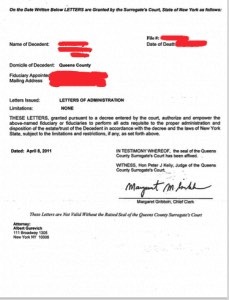
We can only offer the flat fee where everyone consents to the process. Where there are disagreements, minor or disabled heirs, or heirs who cannot be located, a different fee applies. Here is a redacted image of New York letters of administration obtained by our office:
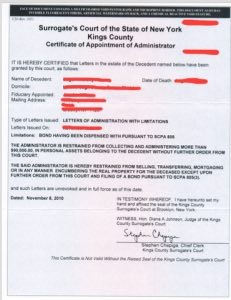
And a redacted image of a Certificate of Appointment of Administrator:
What Estate Administration Means in New York
“Administration” is the Surrogate’s Court proceeding used to settle the estate of a person who died without a will. It is the intestate counterpart of probate, which is the proceeding used when there is a will. The product of an administration proceeding is Letters of Administration, the court document that gives the administrator authority to act for the estate. With letters, the administrator can access bank accounts, sell real estate, file tax returns and, in the end, distribute the estate to the heirs.
Administration is needed whenever the decedent left assets in his or her sole name that require court authority to transfer: bank accounts without named beneficiaries, brokerage accounts without transfer-on-death designations, real estate held in the decedent’s name alone, vehicles and personal property of value. Assets that pass by operation of law — jointly held property, accounts with named beneficiaries and trust assets — are not part of the administration estate and need no court involvement to transfer.
Who Can Serve as Administrator
SCPA § 1001 sets a priority order for appointment. The surviving spouse comes first. If there is no surviving spouse, or the spouse declines to serve, priority passes to the decedent’s children, then grandchildren, then parents, then siblings, then more distant relatives. Within each class, persons of equal rank have equal priority, and the court can appoint any one of them or several of them as co-administrators.
If the people with priority renounce, are disqualified or cannot be located, the right to serve passes down the chain. At the end of the chain is the Public Administrator of the county, who serves where no qualified family member is available and takes a statutory fee for doing so.
The Documents We Prepare
A complete administration filing consists of the following documents, each with its own purpose.
| Document | Purpose |
|---|---|
| Petition for Administration | Opens the proceeding. Identifies the decedent, the date and place of death, the heirs, the assets and the proposed administrator. |
| Oath and Designation | The administrator’s sworn agreement to perform the duties faithfully and to accept service of process in the county. |
| Part 130 Certification | The attorney’s certification that the filings are not frivolous. |
| Affidavit of Heirship, Sole Distributee and/or Family Tree | A sworn statement of the decedent’s family members establishing the family tree. This is the key evidence that the heirs named in the petition are the right heirs. |
| Waivers of Citation, Renunciation and Consents to Appointment | Signed by the other heirs, agreeing to the appointment of the proposed administrator and giving up their own right to be appointed. |
| Bond Affidavit (Affidavit of Assets and Liabilities) | A statement of the estate’s assets and liabilities used by the surety company to set the bond amount. |
| Proposed Decree | The order the judge signs appointing the administrator. |
| Request for Certificate of Appointment of Administrator | Obtains the formal certificates the administrator presents to banks and other institutions. |
How Long Administration Takes
An uncontested administration usually takes between two and six months from the day we are retained to the day Letters of Administration issue. The biggest variables are how quickly the family can produce the death certificate, the identities of the heirs and the asset information; how quickly waivers come back from the non-petitioning heirs; and how quickly the particular Surrogate’s Court is processing filings.
The Manhattan Surrogate’s Court tends to move faster than some of the outer-borough courts, which carry heavier caseloads. The court attorneys review each petition for completeness and accuracy and send back filings with errors. A filing prepared by someone who does this regularly is more likely to clear review on the first attempt, which is one reason the flat fee compares well with a do-it-yourself attempt.
After letters issue, the administration itself — collecting assets, paying debts, distributing to heirs — can take another several months to more than a year depending on complexity. Real estate sales, tax filings and the creditor period all add time.
Bond Requirements
A bond is generally required in administration unless the heirs agree to waive it and the court approves the waiver. The bond is bought from a surety company and is in substance an insurance policy protecting the estate against the administrator’s misconduct. Its cost is paid from the estate and depends on the size of the estate and on the administrator’s credit and other characteristics.
In a modest estate with cooperating heirs, the heirs usually waive the bond, which saves the premium and simplifies the process. The waiver has to be in writing, signed by each adult heir and approved by the court. Heirs cannot waive the bond on behalf of a minor or incapacitated beneficiary; in that case a guardian ad litem may have to be appointed.
Heirs Who Cannot Be Located
The flat fee assumes that every heir can be identified and located and that all of them cooperate. When an heir cannot be found, the court requires diligent efforts to locate the person: searches of public records, contact with last known addresses and sometimes publication of notice. If the heir still cannot be found, that heir’s share may be held by the court or paid to the Comptroller until the heir appears.
If the heir is a foreign citizen, further rules apply. New York has special procedures for distributions to heirs in certain countries where the political situation makes it doubtful that the heir would actually receive the money.
Distributing the Estate
Once letters issue and the administrator has gathered the assets, the next steps are paying the debts and distributing to the heirs under the intestacy rules of EPTL § 4-1.1.
| Decedent survived by | Who takes |
|---|---|
| Spouse and no issue | Spouse takes everything. |
| Spouse and issue | Spouse takes the first $50,000 plus half of the residue; the children divide the other half by representation. |
| Issue but no spouse | Issue take everything by representation. |
| No spouse or issue | Parents take. |
| No spouse, issue or parents | Siblings, and the issue of deceased siblings by representation. |
| None of the above | More distant relatives, in the order the statute sets. |
Before distributing, the administrator pays the decedent’s debts, the expenses of administration and any taxes owed. The administrator should not distribute to the heirs until all known debts are satisfied, because an administrator who distributes before paying creditors can be personally liable for the shortfall.
Closing the Estate
Most administrations close informally. After distribution, each heir signs a receipt and release acknowledging the amount received and releasing the administrator from further claims. Once all the receipts are in hand, the administrator’s job is done; no formal closing decree is needed in a straightforward case.
When the heirs are not all cooperative, or there is a dispute about how the estate was handled, a formal accounting may be necessary. The administrator petitions the court to settle the account and discharge the administrator; the heirs review the accounting and, if it is approved, a final decree closes the estate.
When the Flat Fee Does Not Apply
The flat fee is built for the typical uncontested administration in which all the heirs cooperate. The fee changes when the heirs disagree about who should serve or how the estate should be handled; when there are minor or incapacitated heirs who need a guardian ad litem; when an heir cannot be located after reasonable efforts; when the estate includes complicated assets such as a closely held business, foreign property or significant litigation; when a kinship hearing is needed to establish who the heirs are; or when someone whose status as an heir is disputed contests the estate. In any of those cases we discuss the additional work and a revised fee arrangement with you before proceeding.
To get started, call us at 212-233-1233 or email [email protected].











