







Mr. Goodwin is everything you want in an attorney: professional, honest, thorough, and genuinely caring. He always explains things clearly, so I understood exactly what was happening and what to expect next. His attention to detail and persistence really stood out. Looking back, I feel lucky to have found him. He guided me through the whole process expertly, and I deeply appreciate all his hard work. Would definitely recommend him to anyone needing legal help.
Call Today:
212-233-1233
Trustor vs. Trustee
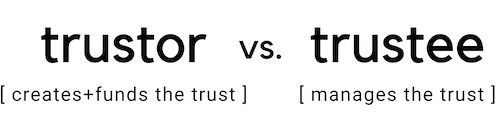
The difference between trustor vs. trustee is this: the trustor creates and funds the trust and the trustee manages the trust.
The trustor, who is the creator of the trust, is also called a grantor or settlor.
The trustor transfers property to the trustee, who then becomes the legal owner of the property and manages such property for the benefit of the beneficiaries.
The difference between trustor vs. trustee is important in understanding trust arrangements. In a trust arrangement, there are three parties: the trustor, the trustee, and the beneficiaries. Even if there are legally three parties, one person can be all three, who “wears three caps” so to speak.
The trustee is the legal owner of the property and manages the trust. However, just because the trustee is the legal owner of the property does not mean that the trustee can benefit from the property unless the trustee is also a beneficiary. The trustee only manages the property for the benefit of the beneficiaries. In return, the trustee is entitled to compensation (called “commission”) for his services in managing the trust.
The beneficiaries, on the other hand, take on a more passive role in a trust arrangement. They simply receive the income or principal from the trust, depending on the terms of the trust agreement. They can request an accounting from the trustee, but they cannot actively manage the trust property.
If you would like a consultation about the difference in trustor vs. trustee, we at the Law Offices of Albert Goodwin can help. You can call us at 212-233-1233 or send us an email at [email protected].
Why the Distinction Matters
The trustor/trustee distinction is more than a matter of vocabulary. It defines who can do what, who is responsible to whom, and how the trust is administered for both legal and tax purposes. Misunderstanding the roles leads to a long list of practical problems — grantors who think they still own assets after putting them into an irrevocable trust, trustees who think they can use trust funds for personal purposes, beneficiaries who think they can direct the trustee. Each role has a specific legal definition, and getting the roles right is the first step in setting up a trust that works.
The Trustor in More Detail
The trustor (also called the grantor or settlor) is the person whose property is going into the trust. The trustor has three powers at the moment of creation: choosing the terms of the trust, selecting the trustee, and transferring assets into the trust. After the trust is signed and funded, the trustor's ongoing role depends on what kind of trust was created.
For a revocable trust, the trustor retains the power to amend, revoke, or unwind the trust at any time during life. The trustor can change beneficiaries, replace the trustee, or pull assets back out. The trust is essentially a will-substitute that gives the trustor full control during life but transitions cleanly at death.
For an irrevocable trust, the trustor gives up most of those powers at the time of creation. Once the trust is signed and funded, the trustor cannot unilaterally undo it. Irrevocable trusts are used for asset protection, Medicaid planning, gift and estate tax planning, and other situations where the trustor needs to relinquish control to achieve the planning objective. The trade-off for the lost control is the benefit the trust provides.
The Trustee in More Detail
The trustee holds legal title to the trust assets and has the authority, and the obligation, to manage them. The trustee's powers come from the trust document, supplemented by the New York Estates, Powers and Trusts Law and the Uniform Trust Code provisions that have been adopted. Typical powers include the power to invest, the power to sell or exchange trust assets, the power to lease real estate, the power to borrow on behalf of the trust, the power to make distributions, and the power to retain professional advisors.
With those powers come duties. The trustee owes the beneficiaries the duty of loyalty (no self-dealing, no conflicts of interest), the duty of care (act with the prudence of a reasonable person managing the affairs of another), the duty of impartiality (treat current beneficiaries and remainder beneficiaries fairly), the duty to account (keep records and provide them on demand), and the duty to follow the terms of the trust. A breach of any of these duties exposes the trustee to surcharge, removal, and personal liability.
The Beneficiaries in More Detail
Beneficiaries are the people for whose benefit the trust exists. Their role is passive in the sense that they do not manage the trust, but they have substantive rights that the trustee must respect. Beneficiaries are entitled to:
- Receive distributions according to the terms of the trust.
- Receive information about the trust — its existence, the trustee's identity, and the general nature of the assets.
- Demand an accounting from the trustee.
- Petition the court if they believe the trustee is mismanaging the trust.
- Object to the trustee's accounting when one is filed.
- Bring proceedings to remove a trustee who is failing in their duties.
Beneficiaries fall into different categories depending on the trust. Income beneficiaries are entitled to the trust's income but not its principal. Remainder beneficiaries are entitled to the principal after the income beneficiary's interest ends. Discretionary beneficiaries receive distributions only when the trustee, in its discretion, decides to make them. Mandatory beneficiaries receive distributions on a set schedule defined by the trust.
When One Person Wears Multiple Hats
It is common for one person to occupy more than one role in a trust. In a typical revocable trust, the trustor, the initial trustee, and a beneficiary are often the same individual. Wearing multiple hats does not cause legal problems as long as the structure is correct. Once the trustor dies or becomes incapacitated, the roles separate: a successor trustee takes over, and the beneficiaries are someone else.
In an irrevocable trust, the multi-hat structure raises more concerns. If the trustor is also the trustee and a beneficiary, the trust may not be effective for the asset-protection or tax-planning purposes for which it was created. The IRS and creditors look at the substance of the trust, not just the titles, and a trustor who retains too much control may find the trust collapsed for those purposes. For irrevocable trusts, the roles should generally be separated to maintain the planning benefits.
How the Roles Interact in Day-to-Day Trust Administration
During the life of a trust, the trustee and beneficiaries interact regularly. The trustee makes investment decisions, files tax returns, and distributes income or principal according to the trust's terms. The beneficiaries receive distributions, ask questions, and review periodic reports. Disagreements usually fall into a few categories:
- The trustee is being too conservative — holding too much in cash, refusing to make discretionary distributions, charging excessive fees.
- The trustee is being too aggressive — making risky investments, distributing too much principal, ignoring the remainder beneficiaries' interests.
- The trustee is not communicating — beneficiaries cannot get information, cannot see the trust's books, cannot understand what is happening with the assets.
- The trustee is self-dealing — using trust assets for personal purposes, buying assets from the trust at low prices, hiring related parties to provide services.
Most of these issues can be resolved through dialogue and proper trust administration. When they cannot, the path forward is a petition in court — for an accounting, for instructions, for removal, or for surcharge.
Choosing a Trustee
The selection of a trustee is one of the most important decisions a trustor makes. The candidates fall into three broad categories: individual trustees (family members, friends, the trustor's attorney), corporate trustees (banks and trust companies), and private trust companies. Each has trade-offs.
Individual trustees are personal, low-cost, and often deeply familiar with the family. They can lack investment sophistication, may have conflicts of interest, and may die or become incapacitated. Corporate trustees bring institutional reliability, professional staff, continuity, and a strong record of compliance. They charge meaningful fees, particularly on smaller trusts, and can feel impersonal. Private trust companies offer many of the corporate trustee benefits at sometimes lower cost, but availability and reputation vary.
For larger or longer-term trusts, the corporate trustee or co-trustee structure (with a family member alongside an institution) is often a good fit. For smaller trusts created during life by parents for adult children, an individual successor trustee is often sufficient.
Talk to a New York Trust Attorney
If you are considering setting up a trust, evaluating a trust that someone else created for your benefit, or dealing with administration issues in an existing trust, we can help. The Law Offices of Albert Goodwin handles trust drafting, administration, and litigation throughout New York.

About the Author
Albert Goodwin Esq. is a licensed New York attorney with over 18 years of courtroom experience. His extensive knowledge and experience make him well-qualified to write authoritative articles on a wide range of legal topics. He can be reached at 212-233-1233 or [email protected].