







Mr. Goodwin is everything you want in an attorney: professional, honest, thorough, and genuinely caring. He always explains things clearly, so I understood exactly what was happening and what to expect next. His attention to detail and persistence really stood out. Looking back, I feel lucky to have found him. He guided me through the whole process expertly, and I deeply appreciate all his hard work. Would definitely recommend him to anyone needing legal help.
Call Today:
212-233-1233
HRA Letter About an Unreported Household Member in Your SNAP Case (NYC)
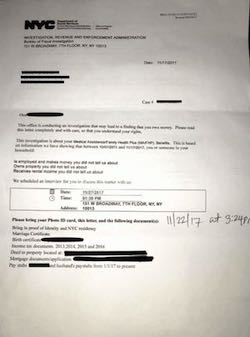
A letter from the HRA Bureau of Fraud Investigation (BFI) about your household composition means an investigator believes that someone lives in your home who was not listed on your SNAP application or recertification. In most of these cases the unlisted person is the father of the children. This page explains how "household" is defined under federal and New York law, what the investigator is likely relying on, the path the case can take after the letter, and the realistic range of outcomes.
Before you call the number on the letter or mail in documents, speak with a lawyer. I am a food stamp fraud attorney in New York City. I do not work for HRA or the District Attorney, and what you tell me is privileged. The consultation is free. Call 212-233-1233.
What the letter is
The letter comes from HRA's Bureau of Fraud Investigation, which sits inside the agency's investigative office rather than the SNAP center that handles your ordinary paperwork. It usually lists a case number, names an investigator, and asks you to come in for an interview or to produce records about who lives at your address. Some letters say only that your case is "under review." Others state that HRA has information that an unreported individual resides in the home and ask you to explain.
The letter is not a charge and not a finding. It is the first visible step in a process that can end in one of four places: the file is closed, HRA asserts an overpayment and asks for repayment, HRA pursues an Intentional Program Violation (IPV) with a disqualification penalty, or HRA refers the file to the District Attorney. Each of those steps is covered in its own section below. For a general overview of HRA investigation letters, including those that do not involve household composition, see responding to HRA administrative letters.
How "household" is defined for SNAP
The question in these cases is not whether the father is involved in the children's lives. The question is whether he is a member of the SNAP household as the regulations define that term. Two rules control.
The purchase-and-prepare test
Under 7 CFR 273.1(a), a household is an individual living alone, an individual who lives with others but customarily purchases food and prepares meals separately from them, or a group of people who live together and customarily purchase food and prepare meals together for home consumption. New York's SNAP regulations at 18 NYCRR Part 387 (definitions at 387.1) adopt the federal definition. Under this rule, two adults who share an apartment but genuinely buy and cook separately can be two separate households.
People who must be in the same household
The purchase-and-prepare test does not apply to everyone. Under 7 CFR 273.1(b)(1), the following people who live together must be treated as one household even if they claim to buy and cook separately:
- Spouses who live together.
- Children under 22 who live with a natural, adoptive, or step parent.
- Children under 18 who live under the parental control of an adult household member who is not their parent.
How an unreported father fits these rules
Apply the two rules to the usual facts and the picture becomes clear:
- You are married and he lives in the home: He is a household member automatically. Whether you consider yourselves separated, and whether you have a separation agreement, does not change the result. The rule turns on where he lives, not on marital paperwork.
- You are not married and he lives in the home: The children are under 22 and living with their natural parent, so under 7 CFR 273.1(b)(1) they must be in his household. They are already in yours. A child cannot be in two SNAP households, so the two merge into one. His income counts whether or not he shares groceries.
- He does not live in the home: He is not a household member regardless of how often he visits, whether he pays child support, whether he keeps a toothbrush there, or whether he claims the children on his tax return. Residence is the only question.
The regulations do not set a number of nights per month that makes someone a resident. Investigators and hearing officers look at where he sleeps most of the time, where he keeps his clothing and belongings, where he receives mail, what address he gives to employers and agencies, and whether he has any other place he can plausibly call home.
Why an extra household member changes the benefit
SNAP eligibility and the monthly allotment are computed from household size and household income under 7 CFR 273.9 and 273.10. Adding an adult raises the household size by one but also adds his gross and net income to the budget. In most cases his wages push the household over the income limit or sharply reduce the allotment. HRA computes the difference between what you received and what you would have received with him in the budget, month by month, for the period it says he lived there. That difference is the overpayment, and it is also the dollar figure that determines whether any criminal charge would be a misdemeanor or a felony.
Two facts therefore drive the entire case: when he lived there, if at all, and what his income was during those months. Both are contestable.
What HRA investigators usually rely on
BFI does not open a file at random. Household composition cases typically start from a data match or a tip and are built from records, not from guesswork. Common sources include:
- Tax filings: The father listed your address on his state return, or claimed the children as dependents, or both. A match between his filing address and your SNAP address is one of the most frequent triggers.
- Wage and address matches: New York State Department of Labor wage reports, Department of Motor Vehicles records, and Social Security records that show his address as yours.
- Housing records: A lease, NYCHA tenant file, or Section 8 recertification that lists him as an occupant.
- Commercial database reports: LexisNexis Accurint and similar services that compile credit header, utility, and mailing address history.
- School and medical records: Forms where he is listed as a parent or emergency contact at your address.
- Field work: A visit to the building, conversations with a superintendent or neighbors, and in some cases surveillance. Surveillance happens, but it is not standard in every case and most files are built on paper.
- Social media: Posts and photographs suggesting a shared home.
- Statements: Something you said at a recertification interview, or something the father said when he was contacted directly.
None of these items is conclusive by itself. A tax return address is a mailing address, and people who move often or live informally with relatives frequently keep one stable address for mail. The IRS allows a noncustodial parent to claim a child as a dependent when the custodial parent releases the exemption, so claiming the children does not establish that he lived with them. A DMV address is often years out of date. The point of a response is to confront each item with the record it actually proves and the record it does not.
What shows that he has a separate residence
HRA's position in these cases is usually that an unmarried father who "stays with a friend" or "stays with his mother" has no actual home elsewhere and therefore lives with you. That is an inference, not a rule, and it can be rebutted with documents tied to the other address:
- A lease, sublease, or room rental agreement in his name, or rent receipts or money transfers to the person he lives with.
- Utility, cable, or phone bills in his name at the other address.
- His driver license, non-driver ID, or voter registration showing the other address, with the date it was issued.
- Pay stubs, W-2 forms, or bank statements mailed to the other address.
- His own SNAP, Medicaid, or cash assistance case at the other address.
- A notarized statement from his landlord or the relative he lives with, describing the arrangement and how long it has lasted.
- A Family Court child support order and payment history, which treats him as a noncustodial parent.
- Orders of protection, if any, and any records showing he was barred from the home for part of the period.
If he did live in the home for part of the period HRA alleges but not all of it, the same categories of documents can fix the move-in or move-out date and cut the overpayment to the months that are actually supportable.
The path after the letter
Step 1: The interview or a written response
The letter asks you to appear or to send documents. You can appear with a lawyer, or your lawyer can contact the investigator and respond in writing on your behalf. The interview is not a casual conversation. Anything you say can be used in an administrative hearing and in a criminal case, and inconsistencies between what you say now and what appears on past recertification forms are often the strongest evidence the agency ends up with. Ignoring the letter does not close the file. It removes your chance to shape the record before HRA decides where to send it.
Step 2: HRA decides what kind of case it is
After the interview or response, HRA chooses among the outcomes below. The choice depends on the strength of the residence evidence, the size of the overpayment, and whether the agency believes the omission was intentional.
Outcome A: No finding
If the response shows he lives elsewhere, or the evidence cannot establish when he lived in the home, the file can be closed with no overpayment and no penalty.
Outcome B: An overpayment claim without a fraud finding
HRA can establish a claim under 7 CFR 273.18 as an "inadvertent household error" rather than fraud. You will receive a notice stating the amount and the months. You can repay in a lump sum, sign a repayment agreement, or have the claim recouped from ongoing benefits (generally 10 percent of the monthly allotment or $10, whichever is greater, for non-fraud claims). Claims that go unpaid can be referred to the federal Treasury Offset Program and taken from tax refunds. You have the right to request a fair hearing from the New York State Office of Temporary and Disability Assistance to dispute the amount or the months.
Outcome C: Intentional Program Violation
If HRA believes you knowingly misstated the household, it can pursue an IPV under 7 CFR 273.16 and 18 NYCRR Part 359. It may ask you to sign a waiver of hearing, which has the same effect as losing the hearing. Otherwise an Administrative Disqualification Hearing (ADH) is scheduled before a state hearing officer, where HRA must prove the intentional violation by clear and convincing evidence. Penalties are a 12-month disqualification for a first IPV, 24 months for a second, and permanent disqualification for a third. The disqualification applies to you as an individual, not to the children, though your income continues to count in their budget. Recoupment on an IPV claim runs at 20 percent of the allotment or $20, whichever is greater. The hearing itself, including how to prepare and what the agency must prove, is covered on the Administrative Disqualification Hearing page.
Outcome D: Referral to the District Attorney
HRA can refer the file for prosecution instead of, or in addition to, the administrative track. Referrals are more likely when the alleged overpayment is large, when the period is long, or when the agency believes forms were deliberately falsified. What a first prosecution typically looks like is discussed on the first-offense food stamp fraud page.
Criminal exposure, by the numbers
The old version of this page said "up to seven years." That figure is accurate only for a specific dollar range, so here is how the statutes actually work.
New York Social Services Law § 145 makes it a misdemeanor to obtain public assistance by a false statement or by concealing a material fact, unless the conduct also violates the Penal Law, in which case the Penal Law penalties apply. Social Services Law § 145-b separately allows the agency to recover a civil penalty, up to three times the amount wrongfully obtained, in a civil action.
Prosecutors generally charge household composition cases under the welfare fraud article of the Penal Law (Article 158), under the larceny article (Article 155), or both, and often add offering a false instrument for filing (Penal Law § 175.35, a class E felony) for the signed application or recertification. The degree depends on the overpayment amount:
- $1,000 or less: Welfare fraud in the fifth degree (Penal Law § 158.05) or petit larceny (§ 155.25). Class A misdemeanor, up to 364 days in jail.
- More than $1,000: Welfare fraud in the fourth degree (§ 158.10) or grand larceny in the fourth degree (§ 155.30). Class E felony, up to 4 years.
- More than $3,000: Welfare fraud in the third degree (§ 158.15) or grand larceny in the third degree (§ 155.35). Class D felony, up to 7 years.
- More than $50,000: Welfare fraud in the second degree (§ 158.20) or grand larceny in the second degree (§ 155.40). Class C felony, up to 15 years.
Those are statutory maximums, not what usually happens. For a first offense with no record, prosecutors in the five boroughs commonly resolve these cases through restitution combined with an adjournment in contemplation of dismissal (CPL § 170.55), a plea to a misdemeanor, or a plea to a reduced felony with probation. The outcome depends on the amount, the length of the period, the quality of the evidence, and your history. No lawyer can promise a particular result, and nothing on this page is a prediction about your case. What the thresholds do show is why fixing the dates and the father's actual income matters: cutting a $4,500 claim to $2,800 moves a case from a class D felony to a class E, and cutting it below $1,000 takes it out of felony range entirely.
What to gather, and what not to send
Gather these for your lawyer
- The letter and its envelope, with the date you received it.
- Every SNAP application, recertification, and periodic report you signed during the period in question. If you do not have copies, your lawyer can request your case record from HRA.
- Budget letters and notices showing your household size and benefit amount by month.
- Your lease and any housing recertifications listing occupants.
- The children's birth certificates and any custody or child support orders.
- The father's separate-residence documents listed above, if they exist.
- Whatever you know about his employment and earnings during the period, because HRA's income assumptions are often higher than his actual pay.
Do not do these before you get advice
- Do not sign a written statement, a repayment agreement, or a waiver of hearing at the interview.
- Do not mail the investigator a stack of bank statements or the father's records without having them reviewed. Documents sent to rebut one point frequently prove another.
- Do not have the father sign a statement you drafted for him. If his account is needed, it should come from him in his own words, and he may need his own lawyer.
- Do not change your recertification answers now to "correct" the past. A new statement that conflicts with old forms creates evidence of intent.
- Do not post about the investigation or about your living arrangement online.
A hypothetical to show how the numbers move
The following is an illustration, not a case result. Assume HRA's letter alleges that the father lived in a Bronx apartment for 36 months and that HRA, using wage-match data, budgeted his income at $3,200 a month, producing an alleged overpayment of about $9,000. On review, his pay stubs show he worked only eight months of that period and earned less than $2,000 a month when he did. Rent receipts and a cable bill place him at his brother's apartment in Queens for the first 14 months. On those facts, the defensible period shrinks from 36 months to 22, and within those 22 months the budget includes his income only in the 8 months he was working. The recalculated claim falls under $3,000, out of class D felony range, and the residence evidence for the earlier period gives HRA a reason to treat the remaining months as an inadvertent error rather than an IPV. Different facts produce different results, but this is the kind of analysis a response is built around.
Common questions
Do I have to go to the BFI interview?
The letter is a request, and you can respond through a lawyer rather than attending alone. Refusing to engage at all does not end the matter; HRA will decide the case on the records it already has. The better course is a response that puts your documents in the file before that decision is made.
If I pay the money back, is the case over?
Repayment resolves the claim, not the question of intent. HRA can accept repayment and still pursue an IPV disqualification or a referral to the District Attorney. How repayment is structured, and what HRA agrees to in exchange, should be negotiated rather than assumed.
He moved out last month. Does that fix it?
Reporting the change now is correct going forward, but it does not change the months already under review. It can also be read as an admission that he lived there before. Report the change through your lawyer as part of the overall response.
Will my children lose their benefits?
An IPV disqualification applies to the adult found responsible, not to the children. The household's benefit is recomputed with you excluded as a member but with your income still counted, so the amount usually drops but does not end. An overpayment claim is recouped from the ongoing benefit regardless of who caused it.
We are married but separated. Doesn't that make him a separate household?
Not if he lives in the home. Spouses who live together are one SNAP household under 7 CFR 273.1(b)(1) no matter what their relationship is. If he lives elsewhere, he is not a member, married or not. For how separation claims are evaluated when Medicaid is also involved, see separation claims in SNAP and Medicaid cases.
Is this the same as a USDA letter?
No. USDA's Food and Nutrition Service investigates retailers, not recipients. If you own a store and received a charge letter about trafficking or other violations, see USDA SNAP retailer violations.
Getting help
If you have received a BFI letter about an unreported household member, call the Law Offices of Albert Goodwin at 212-233-1233 or email [email protected]. I can review the letter and your case record, deal with the investigator so that you do not have to, assemble the residence and income evidence, and represent you in a fair hearing, an Administrative Disqualification Hearing, or criminal court if the matter goes that far. The consultation is free.

About the Author
Albert Goodwin Esq. is a licensed New York attorney with over 18 years of courtroom experience. His extensive knowledge and experience make him well-qualified to write authoritative articles on a wide range of legal topics. He can be reached at 212-233-1233 or [email protected].



