







Mr. Goodwin is everything you want in an attorney: professional, honest, thorough, and genuinely caring. He always explains things clearly, so I understood exactly what was happening and what to expect next. His attention to detail and persistence really stood out. Looking back, I feel lucky to have found him. He guided me through the whole process expertly, and I deeply appreciate all his hard work. Would definitely recommend him to anyone needing legal help.
Call Today:
212-233-1233
How to Get Letters of Administration in New York City
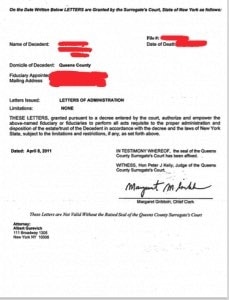
You get letters of administration from the probate court, which in New York is called the Surrogate’s Court. Letters of administration are issued when someone dies without a will; they are the document that proves the administrator’s authority to collect the estate, pay its debts and distribute what remains. You can have an attorney assist you with the process.
Who Has Priority to Be Appointed Administrator
Because there is no will naming a fiduciary, New York law determines who has the right to serve. SCPA 1001 sets the order of priority among the decedent’s distributees: the surviving spouse, then the children, then the grandchildren, then the father or mother, then the brothers or sisters, and then any other distributees, with preference given to the person entitled to the largest share of the estate.
When more than one person shares the same degree of relationship, such as several adult children, each has an equal right to seek appointment, and the others must be given notice and an opportunity to consent or object. If those with priority renounce or are ineligible, the right passes to the next class. Where no eligible distributee will serve, the Public Administrator of the county may be appointed.
Certain persons are disqualified from serving under SCPA 707, including infants, incompetents, felons, and persons the court finds unfit due to dishonesty, substance abuse or want of understanding. Non-U.S. citizens who do not reside in New York generally cannot serve alone and must be joined by a New York resident co-fiduciary.
What Documents You Will Need
An application for letters of administration is a set of papers rather than a single form. The table below lists what the Surrogate’s Court expects and what each document does.
| Document | What it does |
|---|---|
| Petition for administration | Formally asks the court to appoint an administrator and gives the key details about the deceased, the heirs, and the estate’s assets and debts. |
| Oath and designation | Signed by the proposed administrator, who swears to carry out the duties faithfully and designates the county clerk for service of process. |
| Death certificate | The original or a certified copy, proving the death. |
| Copy of the funeral bill | Shows the funeral was paid for, and by whom. |
| Waiver, renunciation and consent | Signed by the distributees, the persons entitled to inherit under EPTL § 4-1.1. Anyone with an equal or higher priority to serve signs this to waive their right. A distributee who will not sign must be cited instead. |
| Citation | Issued by the court to the distributees who did not sign waivers, notifying them of the return date on which the appointment will be considered. |
| Notices | Additional notice requirements depending on the specifics of the case. |
| Affidavit of sole heirship | An affidavit of heirship signed by a disinterested person when the decedent was survived by no heir, one heir, or heirs related through a person who is also deceased. Sometimes it must include a family tree chart. |
| Affidavit of due diligence | The petitioner swears that diligent efforts were made to find any other potential heirs. |
| Other affidavits and documents | Whatever the estate’s facts, assets, debts or special circumstances require. |
| Proposed decree | Drafted by the petitioner’s attorney for the judge’s signature, setting out the appointment and the administrator’s powers and duties. |
After the papers are submitted, the court reviews them and verifies that you are the closest living relative and the person with priority to be appointed. If the Surrogate finds that you qualify, the judge signs the decree and the clerk issues the letters of administration.
Where to File, Filing Fees and Bond
The petition must be filed in the Surrogate’s Court of the county where the decedent was domiciled at death, not necessarily where they died or owned property. Each county’s Surrogate’s Court has its own clerk’s office practices and local preferences for documentation. Filing fees under SCPA 2402 are based on the size of the estate, ranging from $45 for very small estates up to $1,250 for estates of $500,000 or more.
Because the administrator was not chosen by the decedent in a will, the court often requires the administrator to post a bond (a surety undertaking) under SCPA 805 to protect the estate’s creditors and distributees. The bond amount is typically set on the value of the estate’s personal property plus anticipated income. A bond may be reduced or waived where all adult distributees consent in writing, where the letters are restricted so that funds cannot be withdrawn without court order, or in other circumstances the court allows. We routinely obtain consents and structure the petition to minimize or eliminate bonding costs where appropriate.
How Long Does It Take to Get Letters of Administration?
The most important factor is where in New York you are filing. Upstate, it can take less than a month to process an application. In New York City, it can take sixty days for the court even to begin reviewing the application, and it typically takes a few months to get letters of administration. Because of budget cuts and staff shortages, we have seen longer wait times throughout the court system.
If there are issues with your eligibility to serve, or a distributee objects, getting letters of administration can take years and may not happen at all.
What if You Need More Than One Copy
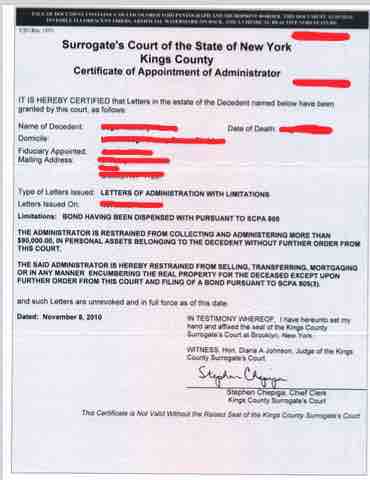
You often need more than one certified copy, since each bank and government agency will want an original. Because some institutions expect a more official-looking document, the court can also issue a Certificate of Appointment of Administrator. It is printed on watermarked blue paper and looks similar to a death, birth or marriage certificate. Here is a redacted image of a Certificate of Appointment of Administrator obtained by our firm.
Small Estates: A Faster Alternative Under SCPA 1301
If the decedent left personal property worth $50,000 or less (real estate is not counted), the estate may qualify for a simplified voluntary administration, or “small estate” proceeding, under SCPA Article 13. A voluntary administrator is appointed through a simplified affidavit process, avoiding the cost and delay of a full administration proceeding. We can evaluate whether your situation qualifies before you file for full letters of administration.
How Our Law Firm Can Help
To obtain letters of administration, we prepare and file the petition for administration with the supporting documents, obtain the waivers or arrange for citation of the distributees who will not sign, represent you before the Surrogate’s Court on the return date, and advise you through every step of the administration that follows. It typically takes a few months to receive the letters after filing; we keep the application moving and resolve disputes or complications as they arise. The governing statute is NY SCPA Article 10.
If you would like representation in obtaining letters of administration, call the Law Offices of Albert Goodwin at 212-233-1233 or email [email protected]. We appear in the Surrogate’s Courts of New York, Kings, Queens, Bronx, Richmond, Nassau, Suffolk and Westchester counties.

About the Author
Albert Goodwin Esq. is a licensed New York attorney with over 18 years of courtroom experience. His extensive knowledge and experience make him well-qualified to write authoritative articles on a wide range of legal topics. He can be reached at 212-233-1233 or [email protected].



