







Mr. Goodwin is everything you want in an attorney: professional, honest, thorough, and genuinely caring. He always explains things clearly, so I understood exactly what was happening and what to expect next. His attention to detail and persistence really stood out. Looking back, I feel lucky to have found him. He guided me through the whole process expertly, and I deeply appreciate all his hard work. Would definitely recommend him to anyone needing legal help.
Call Today:
212-233-1233
How to Look Up Trusts in New York City
You look up a trust by asking the trustee for a copy. If the trustee refuses, a beneficiary can ask the Surrogate’s Court to compel the trustee to produce it. There is no public registry to search.
Unlike a will, which becomes a public record once it is admitted to probate, a trust is a private document. The trustee holds it and shares it with the people entitled to see it. If you are a beneficiary, the way to obtain a copy is to write to the trustee and ask. Another beneficiary who already has a copy can also let you read it. If you are not sure whether you are a beneficiary at all, write to the trustee and ask whether you are named. A trustee must provide a named beneficiary with a copy of the trust instrument. If you are not a beneficiary, the trustee has no legal obligation to give you one.
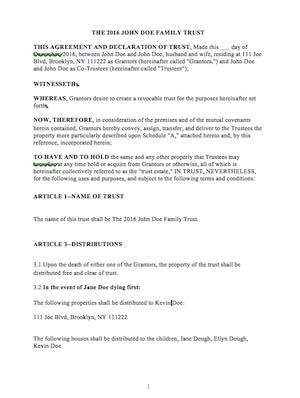
Why trusts are private
Privacy is one of the main reasons people use a trust rather than a will as the centerpiece of an estate plan, and the contrast is sharp. A will admitted to probate is a public record at the Surrogate’s Court, and anyone can request a copy. The probate petition is public too, and it identifies the assets, the beneficiaries and the family relationships. A formal accounting, if one is filed, is public as well.
A trust document, by contrast, is held by the trustee and shared only with the beneficiaries entitled to it. The trust’s existence is not registered anywhere, with limited exceptions for charitable trusts, and a trust accounting is usually delivered to the beneficiaries privately rather than filed with a court. That is why “looking up” a trust the way you would look up a will is generally not possible. The information comes from the trustee, or it does not come at all.
How to find out whether a trust exists
If you suspect a trust exists but no one has told you about it, the paper trail usually starts with the family. Relatives often know that the grantor created a trust during life, and the attorney who handled the grantor’s planning generally knows about any trust that was drafted.
Documents can confirm it. The decedent’s personal tax returns may show distributions from a trust if the decedent was a beneficiary, or contributions to a trust if the decedent was a grantor, and an estate tax return identifies trusts the decedent owned. Real estate held in trust is titled in the name of the trust, so the recorded deed names the trust even though the trust document itself stays private. Bank and brokerage accounts owned by a trust show the trust as the account holder, and trust statements or distribution notices often turn up in the decedent’s personal files.
Where an estate is being administered, the executor has a formal tool as well: a discovery proceeding under SCPA § 2103 to identify trusts and other assets that should be brought into, or accounted for in, the estate.
What a beneficiary is entitled to
Once you know a trust exists and that you are a beneficiary, you are entitled to information about it. The scope of that entitlement depends on the kind of beneficiary you are and on the trust’s terms.
| Right | What it means in practice |
|---|---|
| To know the trust exists | You are entitled to be told that there is a trust and that you are a beneficiary of it. |
| To know who the trustee is | The trustee’s identity and contact information, so requests can be made to the right person. |
| To see the trust document | At least the portions that affect your interest. |
| To periodic information | Reasonable updates on how the trust is being administered. |
| To an accounting | A trustee is not required to account on their own initiative, but a beneficiary may ask for one, and if the trustee will not provide it a beneficiary may petition to compel a formal accounting under SCPA § 2205. See our accountings page. |
A current beneficiary has the broadest rights. A remainder beneficiary whose interest depends on future events has more limited rights, and a discretionary beneficiary’s position falls in between, depending on the instrument.
What a trustee does not have to share
A trustee is not required to supply unlimited information on demand. The trustee may protect the privacy of other beneficiaries by redacting their names and shares in some circumstances. Communications between the trustee and the trustee’s own attorney are privileged and are not disclosed to beneficiaries. A trustee cannot disclose what the trustee does not know. And requests must have a reasonable purpose; a beneficiary cannot use information demands simply to harass the trustee.
If the trustee ignores the request
When a trustee ignores a written request or refuses to let a beneficiary see the trust, the next step is a petition to compel. The petition is filed in Supreme Court for a lifetime trust or in Surrogate’s Court for a testamentary trust. The petition shows that you are a beneficiary, states the specific information you asked for, documents the trustee’s refusal or silence, sets out the legal basis for your right to the information, and asks for an order directing the trustee to provide it within a set time.
If you are a beneficiary, the court will usually grant the order. A trustee who then fails to comply can face contempt sanctions or removal. A trustee can likewise be removed for failing to account when ordered to do so.
Charitable trusts are the exception
Charitable trusts are subject to far more public scrutiny than private ones. New York requires charitable trusts to register with the Attorney General’s Charities Bureau and to file periodic reports, and both the registration and the reports are public records anyone can request. If you are researching a private foundation, a charitable remainder trust whose charitable interest has become current, or another charitable structure, the Charities Bureau registry is the place to start. It is searchable and gives substantial information about the trust’s purposes, leadership and finances.
Privacy ends when litigation begins
When a trust becomes the subject of a court case, its privacy disappears for the purposes of that case. Petitions, briefs, accountings and exhibits become part of the public court record, and the very act of filing puts the trust’s contents into the public domain. Some courts will seal particular filings on application where there is a legitimate confidentiality concern, but the default is public access. A family that values the privacy of its trust should weigh that before bringing a contested matter.
Talk to us
If you are trying to find out whether you are a beneficiary of a trust, or a trustee has refused to give you a copy, we can review your situation and, where the facts support it, prepare the petition and appear for you. Call 212-233-1233 or email [email protected].

About the Author
Albert Goodwin Esq. is a licensed New York attorney with over 18 years of courtroom experience. His extensive knowledge and experience make him well-qualified to write authoritative articles on a wide range of legal topics. He can be reached at 212-233-1233 or [email protected].