
When figuring out how to sign as power of attorney, it is important to know your options. There is no one correct way to sign. As long as you include the name of the agent and the name of the person who gave the power of attorney and indicate that they are the power of attorney agent, most examples are correct.
Here are some examples:
Example 1:
(Agent’s signature)
acting as Agent for (Principal’s name)
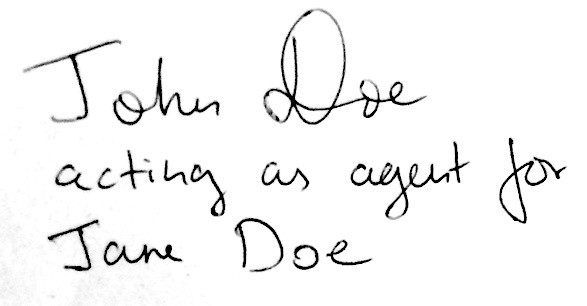
Example 2:
(Principal’s name) by (Agent’s signature) as Agent.

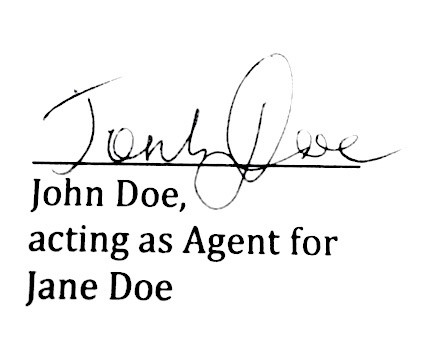
Example 3:
If you can’t tell the agent’s name from the signature, it might be better to pre-print.
A Power of Attorney creates a legal relationship between the principal and the agent. By agreeing to act as a Power of Attorney, the agent agrees to act in accordance with the principal’s instructions, or if there are no instructions, to act in the best interest of the principal. The agent will be responsible for carrying on many financial transactions for the principal, including signing checks, deeds and contracts. It is important to know how to sign as power of attorney in a correct way.
It is important for the agent to act responsibly and keep records of all transactions conducted for the principal by properly keeping a record of receipts, payments and transactions.
As noted above, an agent acting as Power of Attorney will be signing numerous documents on behalf of the principal. It is important for an agent to disclose his identity as an agent when acting on behalf of the principal. Therefore, whenever the agent acts for the principal, he should identify himself as an agent and identify that he is acting for the principal.
The agent can accomplish this by writing the following whenever he is acting on behalf of the principal:
If you need assistance with figuring out how to sign as power of attorney, we at the Law Offices of Albert Goodwin can help. You can call us at 212-233-1233 or send us an email at [email protected].
Why the Signature Format Matters
The way you sign as an agent under a power of attorney is not just a matter of formality. The signature is what tells the world, and specifically the institution accepting the document, that you are acting in a representative capacity rather than as yourself. A signature that does not make that clear can produce confusion, can be challenged later, and can result in you being held personally liable for the transaction.
A correct signature accomplishes two things. First, it identifies the principal — the person whose authority you are exercising. Second, it identifies you as the agent acting under the power of attorney. The signature should make both of these things clear so that no one looking at the document later can plausibly argue that you signed in some other capacity.
When Each Format Works Best
Each of the three example formats above has situations where it works best:
Example 1 — "Agent's signature, acting as Agent for Principal's name." This format is useful when there is room near the signature line to add the explanatory text. It works well on contracts, deeds, and other long documents where the signature appears on its own line with room above and below.
Example 2 — "Principal's name by Agent's signature as Agent." This format puts the principal's name first, which is particularly useful for documents like checks where the principal's name is what the recipient is looking for.
Example 3 — Pre-printed signature line with agent and principal clearly identified. When the agent's handwritten signature is hard to read or when the document will be photocopied or scanned multiple times, pre-printing the agent's name and the principal's name avoids any later confusion about who signed.
Common Mistakes
The most common mistakes we see in agent signatures include:
- Signing only the agent's name. This makes it look like the agent signed in their personal capacity, not as agent. The agent can be held personally liable for the transaction.
- Signing only the principal's name. This can look like forgery. You have written the principal's name as if you were the principal. Even if you intended to act as agent, the document does not show it.
- Signing without indicating the agency relationship. Some agents sign with both names but do not include any "as Agent" or "POA" language. This is better than the prior two mistakes but still leaves room for confusion.
- Using abbreviations like "POA" alone. "POA" is shorthand that not every reader recognizes. Spelling out "as Agent" or "as Attorney-in-Fact" is clearer.
What to Show the Institution
The first time you transact with a particular institution as agent, you typically need to present documentation. The institution will want to see:
- A signed and notarized copy of the power of attorney.
- Identification for the agent (driver's license or passport).
- Sometimes additional documentation such as a Statutory Gifts Rider if the transaction involves gifting.
The institution will review the power of attorney to confirm it grants the specific authority needed for the transaction. Standard New York powers of attorney use a statutory form. Custom powers may also work but receive more scrutiny.
New York's Statutory Power of Attorney
New York revised its power of attorney statute in 2021, with a new statutory short form that consolidates the prior form and the Statutory Gifts Rider. Powers of attorney executed under the old form (before June 13, 2021) remain valid. Powers executed under the new form follow the updated statutory format.
Some institutions are slow to accept powers of attorney, even properly executed statutory forms. The 2021 revisions addressed this by adding penalties against third parties who unreasonably refuse to accept a properly executed statutory power. If an institution refuses, you can sometimes obtain a court order compelling acceptance, with attorney's fees recoverable against the institution.
Banks and Powers of Attorney
Banks are the most common transactional partners for agents acting under powers of attorney. Most banks have their own internal procedures for accepting powers — they want to see the original or a certified copy, they want to verify the agent's identity, and they may want the agent to sign their own internal authorization forms in addition to the power.
To minimize friction at banks, agents should bring the original power, identification, and any supporting documentation when first establishing the relationship. The bank typically photocopies what they need, performs an internal review, and then allows the agent to transact going forward. After the initial setup, transacting becomes routine.
Real Estate Transactions
Selling or refinancing real estate using a power of attorney is one of the most consequential transactions an agent may handle. The title company will require the original recorded power of attorney (or a recordable copy) to be presented at closing, a title affidavit from the agent confirming the principal is alive and the power has not been revoked, sometimes additional identification of the principal, and a power-specific signature block on the deed identifying the agent. If the principal is hospitalized or otherwise unable to attend the closing, additional documentation may be needed.
Tax Filings
An agent can file tax returns on behalf of the principal. The IRS and New York Department of Taxation and Finance accept powers of attorney filed on their own forms (IRS Form 2848, NY Form POA-1). The signature on the return should indicate that the agent is signing in a representative capacity. Many agents include the language "by [agent name] as Agent under Power of Attorney" in the signature block.
Keeping Records
An agent's signature is part of a broader pattern of documentation. The agent should keep records of every transaction conducted for the principal, including the date, the nature of the transaction, the parties involved, and the documentation generated. These records protect the agent if the principal or the principal's heirs later question what was done. They also help the agent prepare an accounting if the principal becomes incapacitated and a guardian is appointed who wants to review the agent's activity.
When in Doubt
If you are not sure how to sign in a particular situation, ask. Banks have power-of-attorney specialists. Title companies have closing attorneys. Brokerages have compliance teams. Spending five minutes on the phone before signing is far better than signing incorrectly and creating problems later. Your own attorney can also advise on specific situations — that is part of what we do for clients who serve as agents.