







Mr. Goodwin is everything you want in an attorney: professional, honest, thorough, and genuinely caring. He always explains things clearly, so I understood exactly what was happening and what to expect next. His attention to detail and persistence really stood out. Looking back, I feel lucky to have found him. He guided me through the whole process expertly, and I deeply appreciate all his hard work. Would definitely recommend him to anyone needing legal help.
Call Today:
212-233-1233
Living Trust vs. Will: What is the Difference
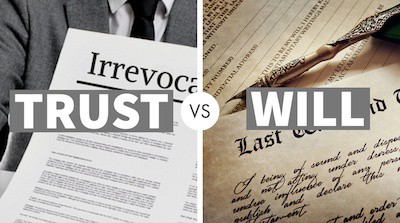
When you are comparing a living trust vs. will, they both accomplish similar things but there are substantial differences between them.
Both a living trust and a will are legal documents which contain a set of instructions for what happens to your assets after your death. The main difference is that for a living trust to work, the property has to be transferred to the living trust while you are alive. Unlike with a will, where the property can stay on your name and will only be transferred to the estate or to your beneficiaries after your death.
In New York, a will requires two witnesses but no notary. A living trust requires a notary but no witnesses.
Whether to dispose of your property through a will or through a living trust depends on your goals. Many people make wills because they are simpler, cheaper and faster and you don’t have to transfer any property during your lifetime.
However, there are also good reasons why a person would choose a living trust over a will, such as:
Flexibility – a living trust can hold assets even after your death, which allows flexibility. In living trust vs will, there is no contest that the living trust provides infinitely more options.
A living trust allows you to disburse funds upon occurrence of an event. In a living trust, the living trustee can disburse fund upon your beneficiary reaching a certain age or life milestone – turning 25, getting married, getting out of rehab, getting out of debt, etc.
A living trust allows you to have your second wife use the funds and have what’s left go to your children from the first marriage. A will does not allow that to happen. The only thing you can do with a will is either leave the property to the first wife or to the children, or some to her and some to the children. In a will, the property has to be disbursed right away in the probate process, vs a living trust, which allows much greater flexibility.
Qualify for Medicaid – There are several types of living trust that can help some individuals qualify for Medicaid, including home care and nursing home coverage. Learn more about Medicaid living trusts.
Protection from creditors and lawsuits. A properly executed and funded irrevocable living trust will shield the principal of the living trust from creditors and lawsuits.
Avoid probate – Probate proceedings can become expensive and delayed. Property that you will transfer to a living trust will not have to go through probate. When looking at living trust vs will, this can be one of the most important considerations.
Protection from your children’s spouses and creditors. You may not want any of your hard-earned assets to go to your child’s spouse, whether in divorce or as an inheritance. You do not want any of the assets you give to your child to go to your child’s creditors, whether as a result of a lawsuit or in bankruptcy.
Maintain privacy – Proceedings in probate court are public record. Any person or organization will be able to find out the extent and location of your assets. Not so with living trusts.
Avoid multiple-state probate proceedings – If you have property in multiple states, you can avoid ancillary probate proceedings by transferring your property into a living trust. Upon your death, the property will pass according to the living trust and multi-state Surrogate’s Court proceedings will not be required.
Protection from irresponsible beneficiaries. A living trust provides limits on how your beneficiaries can spend the assets. For example, you can specify amounts upon reaching a specified age, vs a will where that’s not possible as assets have to be distributed right away.
Avoid interruption of income and use of assets – A living trust provides for the continuity of management of your assets, and avoids interruption of income and use of assets upon your death or disability. Without a living trust, your estate or business may be subject to restrictions imposed by the probate court.
Provide planning for mental disability – A living trust lets you select a living trustee – someone you living trust to manage your estate on your behalf in the event you become unable to do so yourself. Read more in Planning for Disability.
Save money on estate taxes – Living trusts can help you legally save a substantial amount on estate taxes. Read How to Avoid Estate Taxes to learn more about the credit shelter living trust the life insurance living trust. A “QTIP” living trust or a QDT living trust for the benefit of your spouse can further your tax savings goals.
A Charitable Remainder Living trust (CRT) or a Charitable Lead Living trust (CLT) will help you maximize your tax advantage per charitable dollar. A Grantor Retained Annuity Living trusts (GRAT), an Intentionally Defective Grantor Living trusts (IDGT), or a Uniliving trust are advanced living trusts that remove appreciation of your property from your estate. Read more in Advanced Estate Planning.
When you are looking at a living trust vs. will and need help deciding, you can call us at Law Offices of Albert Goodwin at 212-233-1233 or send us an email at [email protected].
New York Execution Requirements: The Statutory Details
The witness and notary requirements for wills and living trusts are set by statute, and the details matter more than the general rule suggests.
- Wills. Under EPTL § 3-2.1, a New York will must be signed at the end by the testator and witnessed by at least two people, who must sign within 30 days of each other. While a notary is not required to make the will valid, in practice virtually every well-drafted New York will is executed with a self-proving affidavit under SCPA § 1406, in which the witnesses swear before a notary that the formalities were followed. This affidavit allows the will to be admitted to probate without locating and questioning the witnesses years later.
- Living trusts. Under EPTL § 7-1.17, a lifetime trust must be in writing and either (a) signed by the creator and the trustee and acknowledged before a notary, or (b) signed by the creator in the presence of two witnesses who also sign. Getting these formalities wrong can invalidate the trust.
A Living Trust Must Be Funded to Work
Signing a living trust is not enough. For the trust to control your assets, you must fund it – actually re-title your house, bank accounts, and other property into the name of the trust. This is the step people most often skip. A trust that is signed but never funded controls nothing, and assets left in your individual name at death will still go through probate, even if you have a trust document sitting in a drawer.
Funding is also an ongoing obligation. As you acquire and sell property over your lifetime, you must keep transferring new assets into the trust. This funding burden, along with the higher upfront cost of drafting, deeds, and re-titling, is a significant drawback to weigh when comparing a living trust vs. a will.
When a Will May Be the Better Choice
For many New Yorkers, a will combined with a power of attorney and a health care proxy is the right plan. A will tends to be the better choice when:
- Your estate is modest or straightforward. If your home passes by deed, your retirement and bank accounts have beneficiary designations or are held jointly, and what remains is small, there may be little reason to incur the cost and ongoing burden of funding a trust.
- You have minor children and need to name a guardian. Guardianship of minor children is appointed through a will, not a trust.
- You want trust-like control without lifetime funding. A will can create a testamentary trust that takes effect at death – for example, holding a child's share until age 25 or 30. Through a testamentary trust, a will can stagger distributions and impose conditions much like a living trust, although the will itself must still be admitted to probate first.

About the Author
Albert Goodwin Esq. is a licensed New York attorney with over 18 years of courtroom experience. His extensive knowledge and experience make him well-qualified to write authoritative articles on a wide range of legal topics. He can be reached at 212-233-1233 or [email protected].



