







Mr. Goodwin is everything you want in an attorney: professional, honest, thorough, and genuinely caring. He always explains things clearly, so I understood exactly what was happening and what to expect next. His attention to detail and persistence really stood out. Looking back, I feel lucky to have found him. He guided me through the whole process expertly, and I deeply appreciate all his hard work. Would definitely recommend him to anyone needing legal help.
Call Today:
212-233-1233
NYC Police Sealed Apartment. How to Get it Opened Through the Court.
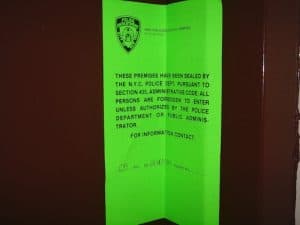
When an occupant of a NYC apartment dies and no relative claims the body or the death occurred under suspicious circumstances, the New York City Police Department comes in to seal the apartment. This seal shows that NYC Police has investigated or is currently investigating the cause of the occupant’s death. It is against the law tamper with or break this police seal.
This seal can present different problems, depending on whether the deceased was a tenant or an owner.
If deceased was a tenant:
The property owner, in this case, would like to acquire back possession of his NYC Police sealed apartment at the soonest possible time in order to rent it out again. The property owner needs to obtain a surrender from an authorized representative of the estate.
If the deceased tenant had a will and the will is petitioned for probate, an executor will be appointed who will then surrender the NYC Police sealed apartment to the property owner. If the deceased tenant had no will, certain family members can be appointed as administrator. If there is no executor or administrator, the property owner or landlord, as creditor, can petition the Surrogate’s Court to appoint a Public Administrator to the Estate in order to receive a surrender of the NYC Police sealed apartment.
But what if the property owner cannot wait for the appointment of an executor or administrator and needs to gain access to his property immediately in order to fix a leak, remove trash, or for any other reason? The property owner can file a suit against the New York City Police Department with the Supreme Court, seeking declaratory judgment and injunctive relief. Because he has filed suit for a temporary restraining order, it will immediately be calendared for hearing by the Supreme Court due to the need for immediate attention.
If deceased was the owner:
If the deceased owner was living alone and NYC police sealed the apartment, there are two scenarios, depending on whether one believes the deceased left a will or not. If one believes the deceased left a will, the next of kin or their authorized representative can file a petition to unseal the residence and examine the NYC Police sealed apartment.
Once the Surrogate Court issues the order granting the petition, the next of kin can coordinate with the police precinct holding the apartment keys.
NYC police will be present when the sealed apartment is opened and a search is conducted to find the will and insurance policies. After the search, the police seals back the apartment.
If a will is found, one can proceed to probate the will, and an executor (if named in the will) is appointed. If, on the other hand, one believes that the deceased did not leave a will, the next of kin can skip the petition to unseal and just proceed with the petition for the issuance of letters of administration. Access to the apartment can be gained again only when an executor or administrator has been appointed and authorized to gather and distribute the decedent’s assets to the heirs or beneficiaries.
If the deceased owner was living with someone (for example, a sibling, another family member, or a friend) and this person has no tenancy or ownership rights to remain in the residence, the executor or administrator can petition either the Surrogate's Court or landlord-tenant court to obtain an order of eviction to get possession of the apartment from the individual wrongfully occupying estate property.
Why NYPD Seals the Apartment
When a person dies in their apartment under circumstances that require investigation — or when the body is discovered without an immediate next of kin to claim it — NYPD's role is broader than simply notifying the family. The seal serves several legitimate purposes:
- Preserving evidence in case the death turns out to involve foul play.
- Protecting valuables in the apartment from being taken before lawful authority is established.
- Preventing unauthorized people from entering and disturbing the scene.
- Allowing the medical examiner to complete autopsy and identification.
- Giving the family time to organize the legal authority needed to access the apartment.
The seal is typically a strip of police tape across the door with a printed notice warning that tampering with the seal is a crime. The seal remains in place until the police voluntarily remove it or a court order directs removal.
The Petition to Examine the Residence
The petition under SCPA § 2103 (and related provisions) is the standard procedural tool for getting access to a sealed residence. The petition typically:
- Identifies the decedent and the date and circumstances of death.
- Identifies the residence and the seal.
- Identifies the petitioner and the petitioner's relationship to the decedent.
- Specifies what the petitioner needs from the residence (will, insurance policies, financial records, etc.).
- Explains why the access is urgent.
- Requests an order directing NYPD to provide controlled access at a scheduled time.
The Surrogate's Court can act quickly on these petitions when needed. We have obtained access orders within days of filing in urgent cases.
What Can Be Removed During the Examination
The Order to Examine the Residence typically limits what can be removed:
- The original will (if found).
- Insurance policies and related papers.
- Deeds and other property records.
- Financial records (bank statements, brokerage statements).
- Burial plot deeds and funeral-related documents.
- Personal items needed for the funeral (clothing, photos for the service).
The order does not typically permit broader removal of personal property, valuables, or other items. The full inventory and disposition of the apartment's contents waits for the appointment of an executor or administrator with full authority.
The Eventual Probate or Administration Process
Once the will is found (or the absence of a will is confirmed), the family proceeds with full probate or administration. Once the executor or administrator is appointed and letters are issued, the executor/administrator can:
- Take full control of the apartment.
- Change the locks (after notifying NYPD that the seal can be removed).
- Inventory and value the contents.
- Continue paying carrying costs (rent, insurance, utilities).
- Eventually dispose of the contents according to the will or by sale.
- Surrender the apartment to the landlord (if tenant) or sell/transfer it (if owner).
Rental Apartments and Lease Termination
For tenant decedents, the lease relationship continues until properly terminated. The landlord cannot simply re-rent the apartment because the tenant died. The estate has continuing rights and obligations under the lease until:
- The lease expires by its terms.
- The estate surrenders the apartment.
- The lease is terminated by court order (such as in an eviction proceeding).
The estate is generally responsible for rent during this period. The landlord can require continued payment from estate funds. If the estate stops paying, the landlord can bring a non-payment proceeding against the estate.
For both the landlord and the estate, the practical answer is usually a negotiated surrender of the apartment within a defined timeframe. The estate clears out the contents, hands over the keys, and the landlord releases the estate from further obligations.
Co-op Apartments
Co-op apartments add complications. The estate owns shares in the cooperative corporation plus a proprietary lease. Transferring or surrendering the co-op interest requires coordination with the co-op board and management. The board may have transfer requirements that include approval of any new shareholder. Selling the co-op interest involves the standard co-op transfer process applied to an estate transaction.
Items of Sentimental Value
One of the more emotionally difficult aspects of sealed apartments is access to items of sentimental value. Family photos, personal mementos, religious items, and similar property cannot be removed during the initial examination order but become accessible once the estate is fully open. Families should be patient about this aspect — the items are safe in the sealed apartment and will eventually be available.

About the Author
Albert Goodwin Esq. is a licensed New York attorney with over 18 years of courtroom experience. His extensive knowledge and experience make him well-qualified to write authoritative articles on a wide range of legal topics. He can be reached at 212-233-1233 or [email protected].