







Mr. Goodwin is everything you want in an attorney: professional, honest, thorough, and genuinely caring. He always explains things clearly, so I understood exactly what was happening and what to expect next. His attention to detail and persistence really stood out. Looking back, I feel lucky to have found him. He guided me through the whole process expertly, and I deeply appreciate all his hard work. Would definitely recommend him to anyone needing legal help.
Call Today:
212-233-1233
Successor Trustee. How One Succeeds the Original Trustee in New York.
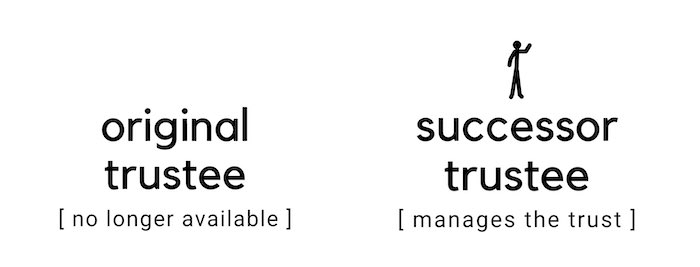
A successor trustee is a person who succeeds or replaces a previous or former trustee, because such previous or former trustee has died, resigned, was suspended, removed, or for any other reason, is unable to act.
This is in contrast to a trustee, who is a person appointed by the trustor or grantor (the creator of the trust) to own and manage the trust assets for the benefit of beneficiaries.
Resignation, suspension, or removal of the original trustee
Under EPTL § 7-2.6, a trustee may resign or be suspended or removed by the court on the application of an interested person due to a violation of the trust, insolvency, or unsuitability to execute the trust.
Usually, the trust agreement will provide for the mechanism of appointing a successor trustee, such as an appointment by a prior trustee or a protector or by a majority vote of the beneficiaries. However, if there is no method provided in the trust agreement, the court may appoint a receiver or other officer under its direction. EPTL § 7-2.6.
If the trust is a testamentary trust, however, the appointment of the successor trustee is done through an application with the Surrogate’s Court.
Succession of a successor trustee
To succeed a previous trustee, the successor trustee has to ensure that he is indeed the successor trustee. There is a need to refer to the trust document to see who the successor trustee is and what kind of powers and authority the successor trustee has.
Since a trustee is the legal owner of trust assets, when a previous or former trustee dies or is replaced for whatever reason, the successor trustee will be the new legal owner of the trust assets. There is a need to transfer ownership over the trust assets to the new successor trustee.
If the previous trustee died, establishing authority as the new successor trustee is simple by just submitting the death certificate of the previous trustee and proof that you are the successor trustee (usually through an affidavit or certificate of trust where you affirm you are the successor trustee under penalty of perjury).
For example, if the trust asset is real property, the real property will be in the name of X, Trustee of ABC Trust. If X died and you are the successor trustee, you need to transfer the real property from X to you, Trustee of ABC Trust. Since real property transfers are recorded with the local government and approved by the title examiner, the examiner will request proof that the previous trustee has died and you are the successor trustee with legal authority to transfer the real estate to you.
If the trust asset is a bank account, the bank account will be in the name of X, Trustee of ABC Trust. If you are the successor trustee and you need to transfer the bank account in your name, the bank will also ask for relevant documents constituting proof that the previous trustee died and your authority as successor trustee.
It becomes a little bit more difficult to prove you have authority as successor trustee when the previous trustee did not die but instead became incapacitated. In this case, the trust agreement will provide for the evidence required to prove that the previous trustee was incapacitated, allowing you as successor trustee to step in. Normally, you will need a certificate from the previous trustee’s physician that such trustee is incapacitated and incapable of managing the affairs of the trust.
If you run into problems regarding transfers of property to a successor trustee, a trust and estates lawyer, like us, can help you.
Successor trustee in revocable trusts
In revocable trusts, the grantor is the orignal trustee and the person who takes over the trust after the grantor dies is the sucessor trustee.
Many trusts are revocable trusts because many grantors do not like to relinquish control over their property until their death. A revocable trust allows the grantor to continue possessing and owning the property during his lifetime and to change the trustee and the beneficiary at any time prior to his death. It is only when the grantor dies that the trust becomes irrevocable.
In most revocable trusts, the grantor designates himself also as trustee and beneficiary. This allows the grantor to exercise absolute control over his property during his lifetime. The grantor then designates successor trustees and successor beneficiaries who will succeed him upon his death, incapacity, or for whatever triggering event the grantor might like.
Examples
Example 1: X establishes ABC trust where X names himself as trustee and beneficiary. In order for the trust to be effective, X needs to transfer property to ABC Trust. X transfers his house to the trust. A new deed is registered, transferring the house from X to X, Trustee of ABC Trust.
In the trust document, X names you as successor trustee, and his children, B and C, as successor beneficiaries. You are to succeed as trustee upon his death or incapacity, whichever comes earlier.
If X dies, you need to submit a deed to the title examiner in the local government, transferring the house from X, Trustee of ABC Trust to you, Trustee of ABC Trust. The title examiner will request proof that X is no longer the trustee of ABC Trust and you are the successor trustee. To prove death, you can submit the death certificate. To prove your status as successor trustee, you can submit an affidavit. A trust and estates lawyer, like us, can help you prepare the relevant documents for the transfer.
Example 2: Same facts as above, except that X named his spouse, Y, as successor trustee. There was no other successor trustee named and no other method to choose a successor trustee. At the time of X’s death, Y was already in a Medicaid-certified nursing care facility and would not be able to manage the trust. You are X’s child, one of the named successor beneficiaries. What is your remedy? You need to file an application with the court for the appointment of a successor trustee since the trust was created during the lifetime of X. If the trust was created in X’s will, the application is filed with the Surrogate’s Court.
The appointment and transfer of trust properties to successor trustees are usually more complex than the appointment of the original trustee. In the appointment of an original trustee, the mere transfer of ownership of the trust properties to the trustee is enough evidence of the appointment of a trustee and the trustee’s acceptance of the trust. For successor trustees, they need to strictly follow the procedures outlined in the trust document in order to step in as a trustee. If the trust document is silent, the grantor’s intentions are inferred from the general terms of the trust agreement.
There is more about rules governing successor trustees in EPTL § 7-2.6.
If you are a successor trustee who needs assistance in the transfer of trust properties in your name or you are a beneficiary who needs to have a successor trustee appointed or if you have any issues regarding a trust document, we at the Law Offices of Albert Goodwin can help. We have represented both trustees and beneficiaries in many cases involving different issues. We have offices in New York City, Brooklyn, NY and Queens, NY. You can call us at 212-233-1233 or send us an email at [email protected].
Can a Successor Trustee Change the Trust?
A question we often hear from successor trustees and beneficiaries is whether a successor trustee can change the terms of the trust, such as adding or removing beneficiaries. The answer is almost always no. A successor trustee's authority comes entirely from the trust document and from New York law, and neither ordinarily grants the power to rewrite the grantor's dispositive plan. The trust document typically gives the trustee broad authority to manage trust assets — to invest, distribute, sell, and lease — but managing the trust is different from amending it. The beneficiaries, the size of their shares, and the conditions for distribution are fixed once the grantor dies and the trust becomes irrevocable. A successor trustee who attempts to add or remove beneficiaries without authority is acting beyond his powers, and the action is voidable.
Limited Ways an Irrevocable Trust Can Be Modified in New York
Although a successor trustee cannot freely change a trust, New York law provides a few narrow mechanisms for modifying an irrevocable trust. None of them allows a trustee to freely rewrite who benefits.
Decanting under EPTL § 10-6.6
New York's decanting statute allows a trustee who has discretionary authority to make principal distributions to pour the trust assets into a new trust with updated terms. Decanting has strict guardrails: the trustee must hold discretionary distribution power; the new trust may not add beneficiaries who were not beneficiaries of the original trust; the new trust may not eliminate a beneficiary's vested or fixed interest beyond what the statute permits; and advance written notice, generally at least 30 days, must be given to the persons interested in the trust. Within these limits, decanting is useful for correcting drafting errors, changing governing law or situs, consolidating trusts, and updating administrative terms — but it is not a backdoor to change who inherits.
Modification by consent under EPTL § 7-1.9
An otherwise irrevocable trust may be amended or revoked with the written, acknowledged consent of the creator (if living) and all persons beneficially interested in the trust. The consents must be executed with the same formality as a deed. This route is rarely practical because "all persons beneficially interested" frequently includes minors, unborn or unascertained beneficiaries, and contingent remaindermen, and the statute has no virtual-representation mechanism to bind them. Where every interested party is identifiable, adult, competent, and willing, however, it can be an efficient way to update a trust without litigation. Note that a beneficiary cannot be removed without that beneficiary's own consent.
Court proceedings
The Surrogate's Court can construe ambiguous trust language, reform a drafting error, or address a failed charitable purpose, but its authority is limited and exercised cautiously. A court will not substitute a trustee's preferences for the grantor's intent.
Trust Protectors
Many modern New York trusts name a trust protector — an individual or institution given limited, defined powers to address future contingencies. A trust protector is not a trustee and does not manage trust assets. The protector's powers exist only as written in the trust document and commonly include the power to remove and replace trustees, amend administrative (not dispositive) provisions, change the trust's governing law or situs, resolve ambiguities, and, in rare and expressly drafted cases, modify dispositive terms or terminate the trust early under defined conditions. If a trust includes a protector with the appropriate authority, certain changes can be made after the grantor's death without going to court. A successor trustee who has not been given a valid protector role cannot exercise these powers.

About the Author
Albert Goodwin Esq. is a licensed New York attorney with over 18 years of courtroom experience. His extensive knowledge and experience make him well-qualified to write authoritative articles on a wide range of legal topics. He can be reached at 212-233-1233 or [email protected].