







Mr. Goodwin is everything you want in an attorney: professional, honest, thorough, and genuinely caring. He always explains things clearly, so I understood exactly what was happening and what to expect next. His attention to detail and persistence really stood out. Looking back, I feel lucky to have found him. He guided me through the whole process expertly, and I deeply appreciate all his hard work. Would definitely recommend him to anyone needing legal help.
Call Today:
212-233-1233
What is an Executor of an Estate – What they Do and How they Do It

An executor of an estate is named in the will as the person in charge of the estate. The executor of an estate is responsible for carrying out the wishes and intent of the person who made the will. They must act in good faith and by representing the best interests of the beneficiaries at all times during the probate administration of the estate and winding up and closing of an estate.
When choosing an executor, you should keep in mind qualities such as experience, ability to handle and manage business matters, competency and availability. You may appoint a spouse, another family member, friend, attorney or any other person over the age of 18 years of age to act as the executor. It is common to appoint a successor executor of an estate as a backup, just in case something happens to the executor of an estate by the time you die. Some people choose to appoint co-executors, to have more than one person be responsible to carry out their wishes.
The Executor’s Responsibilities
An executor of an estate can initiate the filing of a probate proceeding with the Surrogate’s Court by filing the original will and death certificate with the court and is responsible for obtaining and filing any other necessary documentation that the Court may require. An executor’s duties vary and may include the following:
- Managing the estate assets including bank accounts, stock, bonds, retirement accounts, pensions
- Taking inventory of assets, including personal and real property
- Investing assets
- Selling personal and real property
- Distributing assets
- Paying creditors and other claims including funeral expenses and any estate taxes that may be due out of estate assets
- Contacting an employer to find out about the testator’s employee benefits
- Managing the testator’s business
- Making accountings
- Communicate with the beneficiaries on a regular basis to keep them informed of important financial matters
- Resolving disputes that may arise between beneficiaries
- Winding up and settling the estate
There are all sorts of other contractual or legal matters that may require an executor’s attention. For instance, if the testator owned commercial property and had tenants, the executor of an estate may have to collect rents, work with a property management company or hire one depending on the size of the building and the number of tenants. The executor of an estate may have to work with attorneys and accountants in order to make sure assets are properly valued and contractual obligations are completed.
An executor of an estate is entitled to receive compensation for his or her services in accordance with the rates set by law. When a spouse or a family member acts as executor, many times they do not take compensation for their services, especially when they are also a beneficiary receiving a distribution of assets under the will.
Letters Testamentary
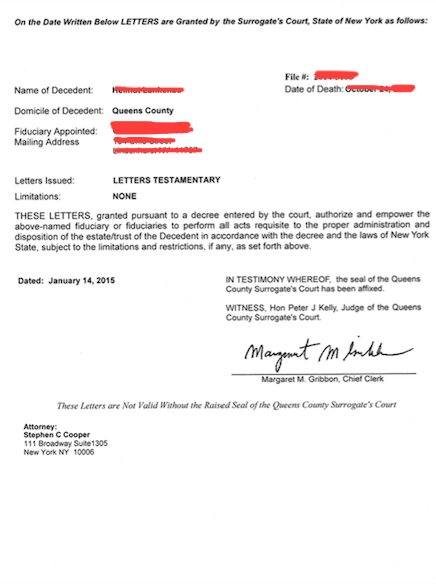
An estate executor of an estate is someone who is in charge of an estate due to being nominated in the will. Being nominated as an executor of an estate in an estate in and of itself is not enough to start acting on behalf of an estate. One has to first go through the probate process and be appointed by the court and receive a legal document called “Letters Testamentary.”
Letters Testamentary is a document has many safety features, such as watermarks. It looks similar to other New York documents that have to do with birth and death: Letters Testamentary look similar to a birth certificate or death certificate. The executor of an estate of estate will receive Letters Testamentary from the Surrogate’s Court. It which would look something like this:
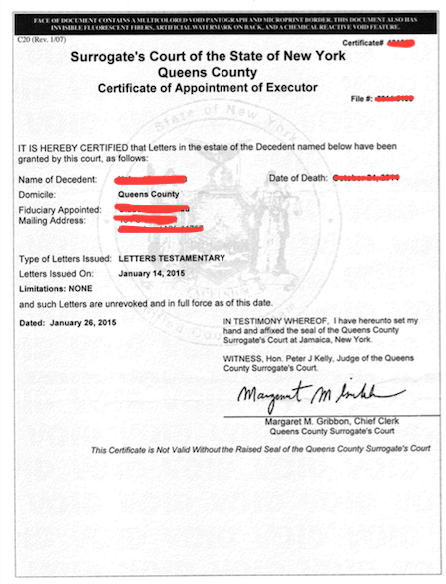
Once appointed, an executor of an estate will receive enough Certificates of Appointment of Executor of an estate to present to every bank and other institution when they marshal the assets of the estate. The Certificates of Appointment also have watermarks and security features. The certificates cost $6 each and can be obtained from the cashier in the courthouse. This is what a Certificate of Appointment of Executor of an estate would look like:
Preliminary Executor of Estate
If someone is objecting to the appointment of an executor, or the court is waiting for additional documents, but assets of the estate need to be taken care of, the court can issue preliminary letters testamentary, which give a person the power to take care of the estate assets but does not give them the power to disburse the assets to the beneficiaries of the estate.
In recent times, we have noticed that courts are more reluctant to appoint preliminary executors, as the extra work puts a strain on the court’s resources. We are trying to not apply for preliminary executorship unless necessary in the case.
Notice to All Heirs and Potential Heirs
An executor of an estate is required to give the proper notice to people affected by their appointment to that role.
A person who wishes to get appointed as the executor of an estate has to give notice of the probate proceeding to everyone who inherits under the will, relatives who would have inherited if not for this will, and people who would have inherited under a prior will that was overwritten by the current will.
Notice of probate is sufficient to people inheriting under the will. For people whose prior inheritance rights are terminated by the will, a citation issued by the court will be required.
In order to get appointed to be in charge of an estate, the potential executor of an estate will need to either obtain written waivers and consent of the people they notified or have to schedule a hearing date where the people notified of the date have a chance to appear and voice any of their reservations.
Affidavit of Sole Heirship
Whenever an executor of an estate is the sole heir of the decedent, they may be required to submit an affidavit of sole heirship, whereby a non-interested party who is familiar with the family of the person who died or a professional genealogist or perhaps even the attorney representing the executor of an estate who did the right research signs an affidavit which explains the family situation of the person who died and how it worked out that the person who died left only one heir.
Executor of an Estate Commissions
Executors are usually entitled to compensation. This compensation is called “commissions.” The amount an executor of an estate is paid in New York is set by law, in SCPA 2307. Here are the commission percentages:
• 5% of the first $100,000
• 4% of the next $200,000
• 3% the next $700,000
• 2.5% of the next $4 Million
• 2% of the rest of the value of the estate
Fiduciary Duty of an Executor of Estate
An executor of an estate is held a higher standard of behavior and is expected to act in an honest, fair and ethical manner. If an executor of an estate breaches their fiduciary duty, the executor of an estate could be held legally liable for any losses suffered by the estate or beneficiaries. An executor of an estate in New York can be removed by the beneficiaries for breach of fiduciary duty and could be subject to restitution of any financial losses to the estate and beneficiaries, as well as face criminal charges if the executor of an estate committed any crimes such as embezzlement of estate assets.
Acting an executor of an estate is a big responsibility, especially if an estate is large and has substantial assets. That is why some spouses or family members decide they do not want to take on the job and end up resigning and hiring an attorney or another personal representative to replace them and administer the estate.
If you wish to speak to hire a New York estate attorney to assist you with your duties as executor, call the Law Offices of Albert Goodwin at (212) 233-1233.
Who Cannot Serve as an Executor in New York
Not everyone named in a will is eligible to serve. Under SCPA 707, the Surrogate's Court will not issue letters testamentary to persons who are ineligible, including:
- Persons under 18 years of age
- Incompetents
- Felons
- Non-domiciliary aliens, except in limited circumstances
- Persons the court finds unfit to serve, such as for dishonesty, substance abuse, or improvidence
If the person nominated in the will is disqualified, the court may appoint the successor executor named in the will or, if none is available, another eligible person.
Do You Need a Lawyer to Become an Executor?
New York does not require you to hire a lawyer to become executor of an estate. A named executor who is not disqualified under SCPA 707 may file the probate petition as a self-represented (pro se) petitioner in the Surrogate's Court of the county where the decedent lived. Keep in mind, however, that Surrogate's Court clerks cannot give legal advice or correct your papers for you.
Being appointed is one thing; carrying out the administration is another. Whether you should hire a lawyer depends on the facts of the estate. Simple estates with a few bank accounts, no real property, and cooperative beneficiaries are frequently handled without counsel. A lawyer is strongly recommended or effectively required when:
- The estate includes a house, co-op, or condo that must be transferred or sold
- An heir or beneficiary signals a possible will contest or objection
- A missing or unknown distributee requires service by publication or the appointment of a guardian ad litem
- The estate exceeds the New York or federal estate tax threshold
- The estate includes a closely-held business, LLC, or partnership interests
- Assets are being withheld by a third party, requiring a discovery and turnover proceeding
- The estate includes real estate located in another state, requiring ancillary probate
Self-represented filings most often stall for predictable reasons: missing a distributee or botching service, failing to anticipate a guardian ad litem for an infant or incapacitated party, errors in recording a deed out of the estate, and missed tax deadlines that carry personal exposure for the executor. Because an executor can be personally surcharged for these mistakes, and because attorney fees are paid from the estate rather than from the executor personally (subject to the court's review for reasonableness), hiring counsel is usually a modest cost relative to the risk.
Note that if you hire a lawyer, you remain the executor and the decision-maker. The attorney advises you and prepares the filings; the fiduciary responsibility stays with you.
Filing Fees and Small Estates
The probate filing fee is keyed to the size of the estate under SCPA 2402, ranging from $45 for very small estates up to $1,250 for estates of $500,000 or more.
If the estate consists of personal property of $50,000 or less and no real estate, it may qualify for Voluntary Administration under SCPA Article 13. This simplified small-estate procedure uses an affidavit instead of full probate and is the scenario most realistically handled without a lawyer. In a Voluntary Administration, the person in charge is called a voluntary administrator rather than an executor.
Who Is Eligible to Serve as Executor: SCPA § 707
Being nominated in the will is not enough — the Surrogate's Court must also find that the nominee is eligible to serve. Under SCPA § 707, the following persons are ineligible to receive letters testamentary:
- An infant (a minor under 18)
- An incompetent person (someone judicially declared unable to manage their affairs)
- A non-domiciliary alien, a person who is both a non-U.S. citizen and lives outside New York, unless serving together with a New York resident co-fiduciary
- A felon (anyone convicted of a felony)
- A person the court finds unfit because of substance abuse, dishonesty, improvidence, want of understanding, or other reasons rendering them unfit to execute the office
A few points of confusion come up often. A U.S. citizen who lives in another state is not disqualified — only a non-citizen living outside New York is barred from serving alone. A felony conviction, on the other hand, is an absolute bar: unlike "unfitness," which is discretionary with the court, a felony conviction disqualifies a nominee outright. The ability to read and write English is a discretionary factor the court may weigh, not an automatic disqualification.
Where and What to File to Get Appointed
The probate proceeding is governed by SCPA Article 14. The petition is filed in the Surrogate's Court of the county where the decedent was domiciled, their permanent legal residence, at death, not necessarily where they died. If the decedent spent their final months in a nursing home or hospital, their domicile is usually their prior permanent home, not the facility. Each New York City borough (New York, Kings, Queens, Bronx, and Richmond counties) has its own Surrogate's Court.
The core document is the Petition for Probate, form P-1, available on the official New York courts website. A typical probate filing package includes:
- Form P-1 — the Probate Petition, identifying the decedent, the will, the nominated executor, and all distributees and named beneficiaries
- The original last will and testament and any codicils — do not remove the staples or unfasten the pages, even to photocopy, as an altered or de-stapled will invites questions about tampering
- A certified copy of the death certificate
- Signed waivers and consents, or citations for those who must be formally served
- An affidavit of attesting witness, if the will is not self-proving (has no notarized attestation affidavit)
- The filing fee
The Surrogate's Court filing fee for a probate petition is set by SCPA § 2402 and is based on the size of the estate, ranging from about $45 for estates under $10,000 to $1,250 for estates of $500,000 or more. Attorney's fees in New York probate are not fixed by statute; they must be reasonable and, in contested or court-supervised matters, may be reviewed by the Surrogate.
Who the Distributees Are Under EPTL § 4-1.1
The distributees who must receive notice of the probate petition are the people who would inherit if there were no will, determined by the intestacy rules of EPTL § 4-1.1:
- Spouse and issue (children or their descendants): $50,000 plus one-half to the spouse, and the balance to the issue by representation
- Spouse and no issue: everything to the spouse
- Issue and no spouse: everything to the issue by representation
- No spouse and no issue: everything to the surviving parent or parents
- No spouse, issue, or parents: everything to the issue of the parents (siblings, nieces and nephews) by representation
- None of the above: one-half to the paternal grandparents or their issue and one-half to the maternal side, by representation
Identifying and locating distributees is one of the most common causes of delay in getting appointed. If a distributee cannot be found, the court may require a diligent-search affidavit and service by publication, which adds time and cost.

About the Author
Albert Goodwin Esq. is a licensed New York attorney with over 18 years of courtroom experience. His extensive knowledge and experience make him well-qualified to write authoritative articles on a wide range of legal topics. He can be reached at 212-233-1233 or [email protected].