







Mr. Goodwin is everything you want in an attorney: professional, honest, thorough, and genuinely caring. He always explains things clearly, so I understood exactly what was happening and what to expect next. His attention to detail and persistence really stood out. Looking back, I feel lucky to have found him. He guided me through the whole process expertly, and I deeply appreciate all his hard work. Would definitely recommend him to anyone needing legal help.
Call Today:
212-233-1233
Contesting a Will Due to Dementia in New York
When contesting a will due to dementia, you will need to have your attorney file objections to probate of the will. Objections is a document that states that the person who died suffered from severe Dementia and asks the court to reject the will.
Your attorney will file the objections with the court. This filing will set your will contest in motion.
If your relative died recently and had dementia and you are considering contesting their will, call estate attorney Albert Goodwin, Esq. at 212-233-1233 and schedule a consultation.
As an example, here is a front page of a set of objections we’ve filed for one of our clients:
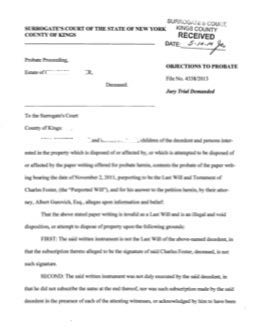
When contesting a will due to dementia, is the diagnosis enough to win? The answer would depend on the extent to which the disease has progressed and if other will contest factors are present, such as fraud, duress and undue influence.
A dementia diagnosis in and of itself does not necessarily win a will contest. Having cognitive issues in and of itself does not bar someone from signing a will as long as they have testamentary capacity at the time that they execute the will. This would be the case even in matters where the person who made the will was under guardianship at the time of executing the will.
New York law states that in order to have testamentary capacity, there must be three things met:
1. the person who signed the will must understand that he or she is signing a will and what a will is,
2. the person who signed the will must have at least a general idea of what their estate entails, and
3. the person who signed the will must know who the “objects of his or her bounty” are, otherwise known as his or her heirs.
A person would be considered to be capable of signing a will if they had dementia only when all of those three things were met at the time of the will being executed.
For signing wills when the person who signed the will has dementia, sometimes the validity of the will depends on whether or not the person who signed the will was having a lucid day on that particular day. If the will was drafted defensively, then the attorney who drafted the will may have adequate documentation, such as a mental evaluation by a doctor and video evidence, showing that the person who signed the will had the testamentary capacity on the day that he or she signed. Most wills, however, are not drafted defensively and mental capacity would have to be determined by witness accounts and medical records. This gives an opening for contesting a will.
What must also be considered is whether someone with dementia may have been the subject of fraud, coercion or undue influence when he or she signed the will. Even someone who has the capacity to sign a will on their own may not have enough capacity to withstand persuasion. Because of that, there are cases where a will contest would be justified even if the person who made the will would have had capacity independently. You can read more about will contests on our website.
If your relative died recently and had dementia and you are considering contesting their will, we at the Law Offices of Albert Goodwin can help. We have offices in New York City, Queens, NY and Brooklyn, NY. You can call us at 212-233-1233 for a consultation.
Different Stages of Dementia and Their Effect on Capacity
Dementia is a progressive condition with different stages, each with different effects on testamentary capacity. Understanding the stages helps in evaluating a specific case:
Mild cognitive impairment (MCI). Memory problems and minor cognitive changes that are noticeable but do not significantly impair daily functioning. People with MCI typically retain testamentary capacity. They can understand the elements of a will and make competent decisions about disposition.
Early-stage dementia. Memory problems become more noticeable, decision-making may be affected, and the person may need assistance with complex tasks. Testamentary capacity is often retained but should be carefully evaluated. Wills signed during this stage can be valid if the specific moment of signing met the capacity standard.
Moderate dementia. Significant cognitive decline affecting daily functioning. The person may not always recognize family members, may confuse the present with the past, and may have difficulty with sustained attention. Testamentary capacity becomes more questionable. Wills signed during this stage face stronger challenges.
Severe dementia. serious cognitive impairment with loss of recognition of close family, inability to communicate complex thoughts, and dependence on others for most decisions. People with severe dementia generally lack testamentary capacity. Wills signed during this stage are very vulnerable to challenge.
The stage at the time of will execution is critical evidence. Medical records, family observations, and other evidence help establish the stage.
Medical Evidence in Dementia Will Contests
Medical evidence is the foundation of capacity challenges based on dementia. The key categories:
Diagnostic documentation. Records showing when dementia was first diagnosed, the type of dementia, and the progression over time. The diagnosis itself does not prove incapacity at any specific moment, but it establishes the underlying condition.
Mental status examinations. The Mini-Mental State Examination (MMSE), Montreal Cognitive Assessment (MoCA), and similar tests measure cognitive function. Test scores around the time of will execution are particularly probative.
Neurological evaluations. Specialist evaluations may document the specific cognitive deficits affecting the testator. Findings about memory, executive function, judgment, and other domains can be relevant to capacity.
Imaging studies. MRI, CT, and PET scans can show brain changes associated with dementia, including atrophy patterns characteristic of Alzheimer's disease and other dementias.
Medication records. Records of cholinesterase inhibitors, memantine, antipsychotics, and other medications can document the severity of the condition and treatment approach.
Hospital records. Hospitalizations often include detailed cognitive assessments. Records from any hospitalization around the time of will execution can be critical.
Nursing home and assisted living records. Daily care records document the testator's cognition and behavior over time. These records are often more probative than periodic physician visits because they show daily functioning.
Lay Witness Evidence
Lay witnesses, people who knew the testator personally, provide important supplementary evidence. They can testify about:
- The testator's appearance and behavior in the period around the will signing.
- Specific examples of confusion, memory loss, or impaired judgment.
- The testator's awareness of family relationships and current events.
- The testator's interactions with the alleged influencer.
- Changes in the testator's personality and decision-making over time.
Lay witnesses cannot give expert medical opinions about diagnosis or capacity, but they can describe what they observed. The cumulative weight of multiple consistent observations can be powerful evidence.
The Lucid Interval Defense
The will's proponent often defends a dementia-affected will by arguing that the testator had a lucid interval at the moment of signing. The defense requires showing:
- The testator's general condition was not so severe that lucid intervals were impossible.
- The specific moment of signing fell within a lucid interval.
- The testator demonstrated the elements of testamentary capacity during that interval.
Evidence supporting lucid interval claims includes:
- The drafting attorney's observations and notes from the signing meeting.
- Witness testimony about the testator's apparent competence at the signing.
- A contemporaneous medical evaluation conducted near the signing.
- Video recording of the signing showing the testator's cogency.
- The testator's specific statements demonstrating understanding of the will.
The lucid interval defense can succeed when the proponent has built a defensive record at the signing. It is harder when the signing was routine and not specifically documented.
The Combination with Undue Influence
Many wills affected by dementia also have undue influence concerns. A testator with cognitive decline is more vulnerable to manipulation by others. Contests typically combine capacity and undue influence theories:
- The testator's cognitive decline made them more susceptible to influence.
- The favored beneficiary exploited that vulnerability.
- The combination of declining capacity and active influence overrode the testator's free will.
The combined theory is often stronger than either theory alone. The capacity evidence supports the influence theory by establishing vulnerability; the influence evidence supports the capacity theory by explaining how the will reflects something other than the testator's own thinking.
The Procedural Framework: SCPA Article 14 and 1404 Examinations
Objections to probate are served and filed under SCPA Article 14 in the Surrogate's Court where the probate proceeding is pending. To file objections, you must have standing, typically, you must be a person who would inherit more if the will were rejected.
Before objections are even filed, an objectant with standing is entitled to conduct SCPA 1404 examinations — pre-objection depositions of the attesting witnesses and the attorney who supervised the will's execution. In dementia-based contests, these examinations are often where the case is won or lost, because they fix the witnesses' recollection of the testator's condition before memories fade. Attesting witnesses frequently report only that the testator "seemed fine," and the 1404 examination is the opportunity to test what that impression was actually based on.
The burdens of proof are divided. The proponent of the will bears the burden of proving valid execution under EPTL 3-2.1 and testamentary capacity under EPTL 3-1.1. The objectant bears the burden of proving undue influence and fraud. The three-part capacity standard applied by New York courts derives from Matter of Kumstar, 66 N.Y.2d 691 (1985), and New York courts have long held that the capacity threshold for making a will is comparatively low — lower than the capacity required to manage one's own affairs or to enter a contract.
Sundowning and the Time of Day the Will Was Signed
Sundowning — the worsening of confusion, agitation, and disorientation in the late afternoon and evening — is a recognized feature of Alzheimer's disease and other dementias. A testator who was relatively clear at 10:00 a.m. may be markedly confused by 6:00 p.m. Because capacity is measured at the moment of execution, the time of day the will was signed becomes genuine evidence in a contest:
- Morning signings, when symptoms are typically mildest, are more defensible than evening signings.
- An attorney's contemporaneous notes recording the testator's condition at a specific time carry substantial weight at trial and on SCPA 1404 examination.
- Care-facility logs frequently record agitation or confusion by the hour, allowing a direct comparison to the time of execution.
Lucid Intervals, Anosognosia, and Why the Type of Dementia Matters
New York has long honored the "lucid interval" doctrine — a will executed during a period of clarity may be valid even if the testator was generally incompetent. Courts have applied this principle for over a century. The decisive question is whether the execution fell within such an interval, which is proven through contemporaneous observations rather than general descriptions of decline.
Anosognosia, the patient's unawareness of their own deficits, is common in Alzheimer's disease. Many patients confidently make decisions they cannot actually comprehend. The testator's apparent certainty at the signing does not establish understanding, a point often missed by attesting witnesses. Relatedly, a person with dementia may appear normal in casual conversation while suffering serious deficits in memory and judgment, and New York courts recognize that a superficial impression of normalcy from a brief meeting does not establish capacity.
The specific type of dementia also matters, because different dementias attack different cognitive functions — and therefore different elements of the capacity standard. Alzheimer's disease typically attacks recent memory first, with judgment and executive function declining later. That progression directly undermines the requirements that the testator know the nature and extent of their property and the natural objects of their bounty. Identifying the type of dementia in the medical records helps connect the diagnosis to the specific capacity element at issue.

About the Author
Albert Goodwin Esq. is a licensed New York attorney with over 18 years of courtroom experience. His extensive knowledge and experience make him well-qualified to write authoritative articles on a wide range of legal topics. He can be reached at 212-233-1233 or [email protected].