







Mr. Goodwin is everything you want in an attorney: professional, honest, thorough, and genuinely caring. He always explains things clearly, so I understood exactly what was happening and what to expect next. His attention to detail and persistence really stood out. Looking back, I feel lucky to have found him. He guided me through the whole process expertly, and I deeply appreciate all his hard work. Would definitely recommend him to anyone needing legal help.
Call Today:
212-233-1233
How to Prove a Will is Fake in New York City
If you want to prove that a will is fake, the best place to start is to bring a copy of the will to an estate lawyer. People usually suspect a fake will because it turned up in suspicious circumstances and something about it does not feel right. We see wills in court constantly and we draft them, so we have a feel for what a genuine one looks like and the experience to recognize one that is not.
Red Flags That Point to a Fake Will
Certain features of a will should make you look harder. None of them proves forgery by itself, but together they are the reason a will “feels wrong.”
| Red flag | Why it matters |
|---|---|
| No attorney’s name on the will | A will prepared without an attorney, such as a form bought at an office supply store or downloaded from the internet, is more likely to be a forgery than one an attorney supervised. An attorney-supervised will carries the attorney’s name and a notarized self-proving affidavit of the witnesses who attested it. Someone could still appear at a lawyer’s office with a fake ID claiming to be the decedent, but forgery is less likely when a lawyer was involved. |
| Missing, misplaced or replaced pages | Pages out of order or absent suggest the will was taken apart and reassembled. |
| Paper that differs in shade, weight or age | A page that does not match the rest may have been substituted after signing. |
| Removed staples, extra staple holes or staple rust | Signs that the original staples were removed point to pages being swapped. |
| White-out, corrections or additions in the text | Touch-ups, erasures and other signs of manipulation make the will look unnatural, and it is often impossible to tell whether they were made before or after signing. |
| A suspicious signature | The “smoking gun,” discussed below. |
The Smoking Gun: The Signature
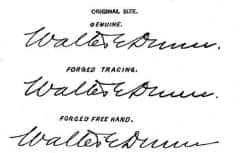
A suspicious-looking signature is the smoking gun of a fake will. Criminals forge signatures either by tracing an original or by practicing it until they can reproduce it freehand. The likeness of a fake signature to the authentic one varies enormously, from nearly identical to nothing like it at all.
Assembling a catalog
When we set out to prove that a signature on a will is fake, one of the techniques we use is to assemble a “catalog” of signatures we believe to be the decedent’s authentic signatures from the same period, taken from other legal documents, checks and similar papers the decedent signed, and compare them with the disputed signature. The more signatures the better, because they compensate for differences in ink, pen, time of day and other variables.
The catalog does not always cooperate. Sometimes the decedent’s own signatures are inconsistent from document to document, which makes it harder to show that the signature on the will departs from a “standard” signature. Sometimes the authenticity of the catalog signatures is itself in question, as when grown children have been signing their elderly parents’ checks. But in most cases the catalog is a sound point of reference for comparing the suspect signature with signatures known to be genuine.
Computer-aided analysis
In a forensic analysis, handwriting experts take a high-quality photograph of the signature and magnify it on a computer. Sometimes magnification alone makes a forgery obvious. In other cases, reversing the colors so that white becomes black and black becomes white, or applying a filter, makes the forgery stand out. That graphic display matters when the task is to convince a jury that a signature is a forgery.
Signs That a Will Is Fake
The “not right” feeling a fake will produces usually comes from one or more of the following features of the signature, each of which is an inconsistency an examiner will count against it.
| What you see | What it points to |
|---|---|
| A completely different signature | The signature on the will matches no verified signature of the decedent; nothing in the catalog looks like it. Some forgers simply take a chance, hoping no one will challenge the will, and produce an outright forgery that does not even resemble the real signature. |
| Constant line thickness | Uniform pressure, so that every stroke has the same weight, suggests tracing. The forger may have used a light-box, or simply held the authentic signature against a window with the fake document over it. Constant pressure comes from writing slowly, more slowly than the real signer would have signed. |
| Unnatural lines | A complex signature has a motion to it. A fabricator who does not know where the real signer starts letters, connects them and ends them produces strokes that look confused and unnatural. |
| Lack of handwriting proficiency | Younger people were schooled in a system that did not emphasize handwriting, and most writing in the past twenty years has been done on a computer, so the older the will’s signer, the better their handwriting skills tend to be. When an older decedent’s signature is forged by someone of the next generation, the inconsistencies often show, because the forger lacks the training and practice to pull off an authentic-looking older signature. |
| Wavy, fuzzy or shaky lines | Unsure lines mean the signature was written slowly, and the effect is visible throughout. That is inconsistent with a natural signature. Some people do have a medical tremor, but shakiness from illness or age would also appear in the rest of the catalog. |
| Markings around the signature | Depending on what they look like, stray marks around a signature can reveal the forgery method. |
| Missing fluidity | Speed and fluidity are part of a natural signature. A signature that lacks them is counted as an inconsistency. Sometimes the examiner has to go by feel and work from there. |
One complication is that people’s signatures are not as unique as they used to be. As handwriting goes out of fashion, handwriting skills deteriorate. Individual styles are being lost, most people print rather than write in script, and handwriting is becoming more uniform. That makes it harder for an expert to prove that a signature is fake.
Forgery Signs That Have Nothing to Do With the Signature
Not every fake will turns on the signature. Manipulated pages and removed staples are red flags in their own right, and so is a will that has been touched up with liquid paper or white-out, or that shows erasures or other signs of alteration. Such “corrections” are sloppy and make the will look unnatural and suspicious. Modifications made after the will was signed are invalid, but it is often hard to tell whether a change was made before or after signing. Unless the lawyer who prepared the will testifies that the corrections were made before it was signed, the court will probably give effect only to the original text as it stood before the modifications.
Improper Execution as a Second Ground
A fake will was usually also made without the formalities a valid will requires, such as the decedent declaring the document to be their last will and testament and signing it before two witnesses. So in addition to alleging forgery, we also object on the ground of improper execution under EPTL 3-2.1, which gives the court a second, independent reason to set the will aside.
Talk to Us
If you need to prove that a will is fake, or you are the executor or beneficiary of a will that someone else says is fake, we can help. Our page on forged will litigation in New York describes the court proceeding itself, and our guide to spotting a forged will covers the same red flags from the other direction. Call 212-233-1233 or write to [email protected].

About the Author
Albert Goodwin Esq. is a licensed New York attorney with over 18 years of courtroom experience. His extensive knowledge and experience make him well-qualified to write authoritative articles on a wide range of legal topics. He can be reached at 212-233-1233 or [email protected].