







Mr. Goodwin is everything you want in an attorney: professional, honest, thorough, and genuinely caring. He always explains things clearly, so I understood exactly what was happening and what to expect next. His attention to detail and persistence really stood out. Looking back, I feel lucky to have found him. He guided me through the whole process expertly, and I deeply appreciate all his hard work. Would definitely recommend him to anyone needing legal help.
Call Today:
212-233-1233
Letter of Probate in New York: What It Means and How to Get Letters Testamentary
New York has no document called a "letter of probate." If you are searching for that term, you are almost certainly looking for one of several documents the Surrogate's Court issues to the person in charge of a dead person's estate. The most common one is Letters Testamentary. This page explains which document you actually need, who qualifies to receive it, the step-by-step procedure under Article 14 of the Surrogate's Court Procedure Act (SCPA), the court filing fees, and what to expect in each New York City county. For the detailed service page on Letters Testamentary, see our Letters Testamentary page. For estates without a will, see Letters of Administration.
What People Mean by "Letter of Probate"
The phrase comes from other states and from England, where a "grant of probate" is the court paper that proves a will and appoints the executor. New York uses different words. When a will is admitted to probate, the Surrogate signs a decree, and the clerk then issues Letters Testamentary to the executor named in the will. The "letters" are not a letter in the ordinary sense. They are a certified court document, with the court's seal, stating that a named person has authority to act for the estate. The term survives from centuries-old English practice in which court orders were written as letters.
A person named as executor in a will has no authority to act until the court issues letters. Banks, title companies, brokerage firms and government agencies will not deal with a nominated executor who cannot produce them. The one exception is the limited authority that EPTL 11-1.3 gives a nominated executor before letters issue: the right to pay reasonable funeral expenses and to take steps to preserve estate property.
Which Document Do You Need?
Several different documents get lumped together as a "letter of probate." The table below shows the correct name for each situation and where to read more.
| Document | When it is issued | Who receives it | Statute | More |
|---|---|---|---|---|
| Letters Testamentary | Decedent left a valid will that names an executor who is eligible and willing to serve | The executor named in the will | SCPA 1414 | Letters Testamentary |
| Preliminary Letters Testamentary | A will has been offered for probate but letters cannot issue yet, usually because a citation is pending or objections are expected | The executor named in the will, with powers the court may limit | SCPA 1412 | See the section below |
| Letters of Administration | Decedent died without a will (intestate) | A distributee, in the order of priority set by statute | SCPA 1001 | Letters of Administration and the administrator's letter |
| Letters of Administration c.t.a. | There is a will, but it names no executor or the named executor has died, declined, or is ineligible | A beneficiary or distributee, in the order set by statute | SCPA 1418 | Administrator c.t.a. |
| Letters of Administration d.b.n. | The original fiduciary has died or been removed and the estate is not finished | A successor fiduciary | SCPA 1007 | Administrator d.b.n. |
| Ancillary Letters | The decedent lived in another state or country but owned New York property | The fiduciary appointed in the home jurisdiction, in most cases | SCPA Article 16 | Ancillary Letters |
| Certificate of Appointment (certified copy of letters) | Any time after letters issue, on request and payment of the fee | The fiduciary, for presentation to banks and agencies | SCPA 2402 | See the section below |
| Small Estate Certificate (Voluntary Administration) | Personal property is worth $50,000 or less and there is no real property to transfer | The voluntary administrator | SCPA Article 13 | See the alternatives section below |
Who Can Receive Letters Testamentary in New York
Being named in the will is the first requirement. The second is eligibility under SCPA 707. The current version of this page's predecessor said only that an executor must be over 18 and not a felon. That was incomplete. Under SCPA 707(1), the court will not issue letters to a person who is:
- under eighteen years of age;
- an incompetent, meaning a person adjudicated incapable of managing their affairs;
- a non-domiciliary alien, meaning a person who is neither a United States citizen nor a New York domiciliary, unless that person serves together with a co-fiduciary who is a New York resident and the court approves;
- a felon, meaning a person convicted of a felony in any jurisdiction;
- a person who does not possess the qualifications required of a fiduciary by reason of substance abuse, dishonesty, improvidence, want of understanding, or who is otherwise unfit for the office.
SCPA 707(2) adds that the court may, in its discretion, decline to issue letters to a person who cannot read and write the English language. The felony ground is the one people ask about most; this page covers it in more detail, including what happens when the only named executor has a conviction. Any person with an interest in the estate may file objections to the issuance of letters under SCPA 709.
If the named executor is ineligible, has died, or signs a renunciation, the will's alternate executor is next. If there is no eligible alternate, the court issues Letters of Administration c.t.a. under SCPA 1418 to a beneficiary or distributee. The estate is still a probate estate; only the title of the fiduciary changes.
How Letters Testamentary Are Issued: Step by Step Under SCPA Article 14
1. File in the right county
Under SCPA 205, the proceeding belongs in the Surrogate's Court of the county where the decedent was domiciled at death. A decedent who lived in Brooklyn is probated in Kings County Surrogate's Court, not in Manhattan, even if the executor lives in Manhattan. If the decedent was domiciled outside New York but owned property here, the proceeding is an ancillary one under SCPA Article 16, filed in the county where the New York property is located.
2. Prepare the probate petition
SCPA 1402 identifies who may petition for probate: the person named as executor, any beneficiary or distributee, a creditor, and certain others with an interest. The petition is filed on the official form and must list the decedent's domicile, the date of death, the approximate value of the probate estate (which sets the filing fee), the names and addresses of every distributee, every beneficiary named in the will, and the executor and alternate executors. In New York City the Surrogate's Courts use electronic filing through NYSCEF, and attorneys are generally required to e-file.
3. File the original will and the death certificate
The court requires the original will, not a copy. If only a copy exists, the proceeding becomes one for a lost or destroyed will under SCPA 1407, which carries a higher burden of proof. A certified death certificate is also filed. A copy of the funeral bill is not a standard probate filing requirement in New York, although funeral expenses are paid first from the estate under SCPA 1811 and the court will ask about them in a small estate proceeding.
4. Obtain waivers and consents, or serve a citation
SCPA 1403 lists the people who must be given notice of the probate: the distributees (the people who would inherit if there were no will), any person named as executor in a prior will who is being displaced, and certain beneficiaries whose interests are cut down by the will offered. Each of these people can sign a Waiver of Process and Consent to Probate, which tells the court they do not object. Every signed waiver removes one person from the citation.
Anyone who does not sign a waiver must be served with a citation, which is the Surrogate's Court equivalent of a summons. The citation sets a return date on which the person may appear and object. Under SCPA 307, the citation must be served at least ten days before the return date when served personally in New York, and longer when served outside the state or by alternative means the court permits. If distributees cannot be located, the court may order service by publication, which adds weeks.
Minors and incapacitated distributees cannot sign waivers. The court appoints a guardian ad litem to review the will on their behalf, which adds time and cost to the proceeding. Where the decedent's closest relatives are cousins or more distant kin, the court will also require a family tree affidavit and proof of due diligence in locating heirs. See affidavit of heirship for how that proof is assembled.
5. Prove the will was properly executed
A New York will must be executed as EPTL 3-2.1 requires: signed at the end by the testator, in the presence of two attesting witnesses, with the testator declaring the document to be their will. The court must satisfy itself that this happened before admitting the will (SCPA 1408). Proof usually comes in one of two forms:
- Self-proving affidavit: under SCPA 1406, if the witnesses signed an affidavit at the time of execution attesting to the formalities, the court can accept that affidavit without calling the witnesses. Most attorney-drafted wills include one.
- Affidavit or testimony of attesting witnesses: if there is no self-proving affidavit, the witnesses must sign affidavits now or testify. If a witness is dead or cannot be found, SCPA 1405 allows proof by other means, including handwriting evidence.
Any party who has been cited may demand to examine the attesting witnesses and the attorney who drafted the will before deciding to file objections. This is the SCPA 1404 examination. It is the first stage of what can become a will contest.
6. Address the bond
Under SCPA 801 a fiduciary must file a bond unless the requirement is dispensed with. Most wills contain a clause stating that the executor shall serve without bond, and under SCPA 806 the court ordinarily honors that clause. The court may still require a bond in its discretion, for example where the named executor lives outside New York or where objections raise concerns about the executor's fitness.
7. Decree and issuance of letters
Once the proof is complete and every necessary party has either waived or been cited and the return date has passed without objection, the Surrogate signs a decree admitting the will to probate. The clerk then issues Letters Testamentary under SCPA 1414. From that point the executor has full authority to collect assets, pay debts and distribute the estate.
Surrogate's Court Filing Fees Under SCPA 2402
The fee for a probate petition is set by SCPA 2402(7) and depends on the gross value of the property passing under the will, as stated in the petition. The current schedule is:
| Value of estate passing under the will | Filing fee |
|---|---|
| Less than $10,000 | $45 |
| $10,000 but under $20,000 | $75 |
| $20,000 but under $50,000 | $215 |
| $50,000 but under $100,000 | $280 |
| $100,000 but under $250,000 | $420 |
| $250,000 but under $500,000 | $625 |
| $500,000 and over | $1,250 |
Assets that pass outside the will, such as joint accounts, accounts with named beneficiaries, and property held in trust, are not counted. Each certified copy of letters (the Certificate of Appointment discussed below) costs $6 under SCPA 2402. A small estate (voluntary administration) petition under Article 13 costs $1. Fees are set by statute and may change; confirm the current amount with the court before filing.
Preliminary Letters Testamentary Under SCPA 1412
Full letters can take months when a citation must be served or objections are filed. SCPA 1412 allows the court to issue Preliminary Letters Testamentary to the executor named in the will while the probate proceeding is pending. Preliminary letters give the executor authority to collect assets, open an estate account, pay bills, and protect property. The court may limit the powers, and it commonly prohibits distributions to beneficiaries until full letters issue. A bond may be required even if the will waives one, because the will has not yet been admitted. Preliminary letters are often issued within a few weeks of filing, which is why they are the first thing to ask for when a building, business, or investment account needs attention and a distributee has not signed a waiver.
What New York Letters Testamentary Look Like
Below are redacted copies of documents issued to executors represented by our office. The fields are the same on every set of letters issued by a New York Surrogate's Court.
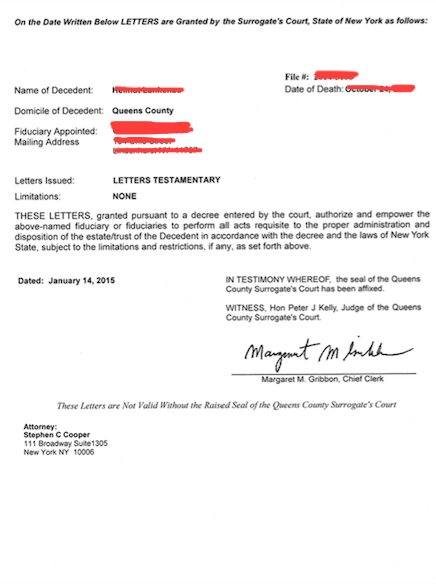
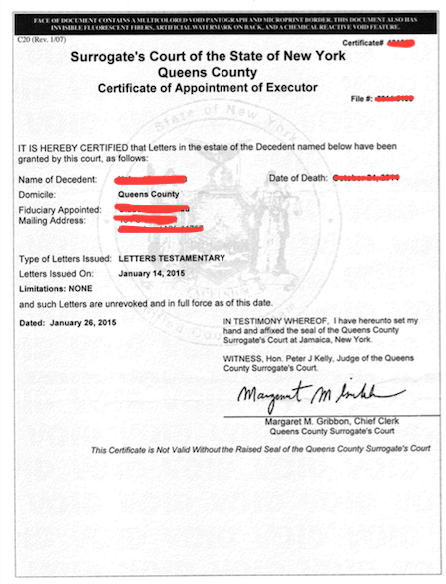
Institutions keep the certificate you hand them, so you should order one for each bank, brokerage, insurance company, pension plan, and government agency you expect to deal with, plus a few extra. The county clerk will require one to record a deed from the estate, and a buyer's title company will require one at a closing.
How Long It Takes in New York City Surrogate's Courts
There is no single answer. The timeline depends on three things: whether every distributee signs a waiver, whether the will has a self-proving affidavit, and which county's court is handling the file. Our sample NYC probate timeline walks through a full case from filing to distribution; the notes below focus only on the time to obtain letters.
- Uncontested, all waivers signed, self-proving will: the petition can be submitted for decree as soon as it is complete. Letters generally issue within several weeks to a few months of filing, depending on the court's backlog.
- Citation required: add the time to serve the citation and the wait until the return date, plus any adjournments. If a distributee must be served out of state or by publication, add several more weeks.
- Guardian ad litem appointed: add the time for the guardian to review the file and report, commonly one to three months.
- Objections filed: a contested probate can take a year or more, and letters may ultimately be denied if the will is not admitted. Preliminary letters under SCPA 1412 are the usual remedy in the meantime.
Caseloads differ among the five boroughs. Kings County and Queens County Surrogate's Courts have historically carried heavier volumes and longer processing times than New York County. Bronx and Richmond County tend to fall in between. Court staffing and e-filing practices change from year to year, so an attorney who files in that county regularly will have the most current sense of the wait. For Brooklyn-specific practice, see our Brooklyn probate page.
When You Do Not Need Letters Testamentary
Full letters are not always required. Before filing a probate petition, check whether one of these applies.
Small estate: voluntary administration under SCPA Article 13
If the decedent's personal property (bank accounts, vehicles, securities, cash) is worth $50,000 or less, and there is no real property in the decedent's sole name that needs to be transferred, SCPA 1301 allows a simplified proceeding called voluntary administration. The petitioner files an Affidavit in Relation to Settlement of Estate under Article 13, pays a $1 fee, and receives a certificate for each asset listed. The certificate works much like letters for that specific asset. The $50,000 limit applies to personal property only; real property in the decedent's name takes the estate out of Article 13 regardless of value. If there is a will, the original is filed with the small estate affidavit.
Assets that pass outside the will
Joint accounts with right of survivorship, accounts with a payable-on-death or transfer-on-death designation, life insurance and retirement accounts with a named beneficiary, and property held in a living trust pass to the survivor or beneficiary without letters. The institution needs a death certificate and the beneficiary's identification, nothing more. If every asset falls into one of these categories, no probate proceeding is needed. See avoiding probate in New York and bank accounts with no beneficiary.
Payments without letters
Certain small payments can be made without any court document. For example, EPTL 11-1.3 lets the nominated executor pay the funeral home before letters issue, and some employers and institutions will release small final paychecks or refunds to the surviving spouse on a death certificate alone. These exceptions are narrow and depend on the institution's own policy.
Out-of-State Wills and Ancillary Letters
If the decedent was domiciled in another state or country and the will was already admitted to probate there, the executor's letters from that jurisdiction do not work in New York on their own. To sell or transfer New York real property, or to collect New York assets that the institution refuses to release, the executor petitions for Ancillary Letters under SCPA Article 16. The petition is filed in the New York county where the property is located, with exemplified copies of the home-state will and letters. Ancillary proceedings are usually faster than an original probate because the will has already been proved.
What an Executor Can Do Once Letters Issue
Letters Testamentary give the executor the powers listed in the will and in EPTL 11-1.1. In practice, the first tasks are obtaining an employer identification number for the estate from the IRS, opening an estate bank account, writing to each bank and institution with a certificate of appointment and death certificate to collect the decedent's assets, and setting up a system to pay creditors in the order SCPA 1811 requires. The executor is also entitled to statutory commissions under SCPA 2307 unless the will provides otherwise. The executor's duties after letters, including accounting to beneficiaries, are covered on our estate accounting page and in the New York probate process overview.
Frequently Asked Questions
Is a letter of probate the same as letters testamentary?
In New York, yes in practice. "Letter of probate" is not a New York term, but people who use it are almost always describing Letters Testamentary, the document issued to an executor after the will is admitted to probate.
Can I get a letter of probate without a will?
No. Probate is the process of proving a will. If there is no will, the equivalent proceeding is administration under SCPA Article 10, and the document issued is Letters of Administration. See administrator of an estate without a will.
Do I need a lawyer to get letters testamentary in New York?
The law does not require one, and an individual petitioner may file without counsel. In practice the court forms, the SCPA 1403 notice requirements, and the proof-of-execution rules trip up many unrepresented petitioners, and a rejected filing can cost months. Estates with real property, a non-self-proving will, missing distributees, or a potential objectant usually benefit from counsel.
How many certificates of appointment should I order?
One for each institution holding an asset, one for each piece of real property to be transferred, and two or three extra. Each costs $6. Institutions commonly reject certificates older than six months, so do not order a large batch at the start if some assets will be dealt with much later.
What if the named executor does not want to serve?
The named executor signs a renunciation, which is filed with the petition. The alternate named in the will then petitions. If no alternate is named or willing, a beneficiary petitions for Letters of Administration c.t.a. under SCPA 1418.
Can a non-citizen who lives abroad be executor of a New York estate?
Not alone. SCPA 707 bars a non-domiciliary alien from serving unless a New York resident serves as co-fiduciary and the court approves. A non-citizen who is domiciled in New York, or a U.S. citizen living in another state, is eligible, although the court may require a bond.
Speak With a New York Probate Attorney
If you have been named executor in a will, or you are a beneficiary trying to understand why the named executor cannot yet act, we can review the will, identify who must be cited or sign waivers, and file the petition in the correct county. Our office handles probate and administration proceedings in all five New York City Surrogate's Courts and on Long Island. Call Albert Goodwin, Esq., New York estate, probate, trust and guardianship attorney, at (212) 233-1233, or read more about our practice.
This page describes New York law and procedure in general terms and is not legal advice for any specific estate. Statutory fees and court practices change; verify current figures with the Surrogate's Court before filing.

About the Author
Albert Goodwin Esq. is a licensed New York attorney with over 18 years of courtroom experience. His extensive knowledge and experience make him well-qualified to write authoritative articles on a wide range of legal topics. He can be reached at 212-233-1233 or [email protected].