







Mr. Goodwin is everything you want in an attorney: professional, honest, thorough, and genuinely caring. He always explains things clearly, so I understood exactly what was happening and what to expect next. His attention to detail and persistence really stood out. Looking back, I feel lucky to have found him. He guided me through the whole process expertly, and I deeply appreciate all his hard work. Would definitely recommend him to anyone needing legal help.
Call Today:
212-233-1233
What is an Executor of Will – What they Do and How they Do It

An executor of will is named in the will as the person in charge of the estate. The executor of will is responsible for carrying out the wishes and intent of the person who made the will. They must act in good faith and by representing the best interests of the beneficiaries at all times during the probate administration of the estate and winding up and closing of an estate.
When choosing an executor, you should keep in mind qualities such as experience, ability to handle and manage business matters, competency and availability. You may appoint a spouse, another family member, friend, attorney or any other person over the age of 18 years of age to act as the executor. It is common to appoint a successor executor of will as a backup, just in case something happens to the executor of will by the time you die. Some people choose to appoint co-executors, to have more than one person be responsible to carry out their wishes.
The Executor’s Responsibilities
An executor of will can initiate the filing of a probate proceeding with the Surrogate’s Court by filing the original will and death certificate with the court and is responsible for obtaining and filing any other necessary documentation that the Court may require. An executor’s duties vary and may include the following:
- Managing the estate assets including bank accounts, stock, bonds, retirement accounts, pensions
- Taking inventory of assets, including personal and real property
- Investing assets
- Selling personal and real property
- Distributing assets
- Paying creditors and other claims including funeral expenses and any estate taxes that may be due out of estate assets
- Contacting an employer to find out about the testator’s employee benefits
- Managing the testator’s business
- Making accountings
- Communicate with the beneficiaries on a regular basis to keep them informed of important financial matters
- Resolving disputes that may arise between beneficiaries
- Winding up and settling the estate
There are all sorts of other contractual or legal matters that may require an executor’s attention. For instance, if the testator owned commercial property and had tenants, the executor of will may have to collect rents, work with a property management company or hire one depending on the size of the building and the number of tenants. The executor of will may have to work with attorneys and accountants in order to make sure assets are properly valued and contractual obligations are completed.
An executor of will is entitled to receive compensation for his or her services in accordance with the rates set by law. When a spouse or a family member acts as executor, many times they do not take compensation for their services, especially when they are also a beneficiary receiving a distribution of assets under the will.
Letters Testamentary
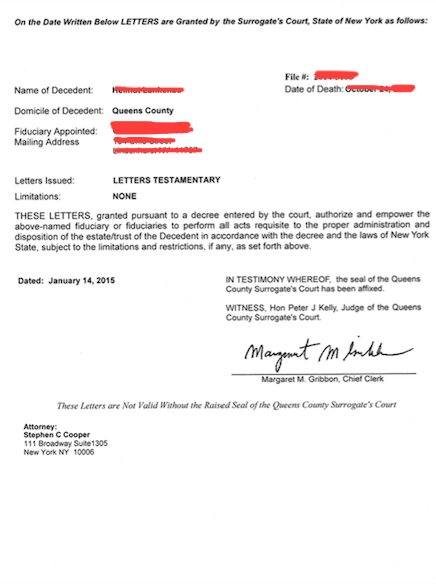
An estate executor of will is someone who is in charge of an estate due to being nominated in the will. Being nominated as an executor of will in a will in and of itself is not enough to start acting on behalf of an estate. One has to first go through the probate process and be appointed by the court and receive a legal document called “Letters Testamentary.”
Letters Testamentary is a document has many safety features, such as watermarks. It looks similar to other New York documents that have to do with birth and death: Letters Testamentary look similar to a birth certificate or death certificate. The executor of will of estate will receive Letters Testamentary from the Surrogate’s Court. It which would look something like this:
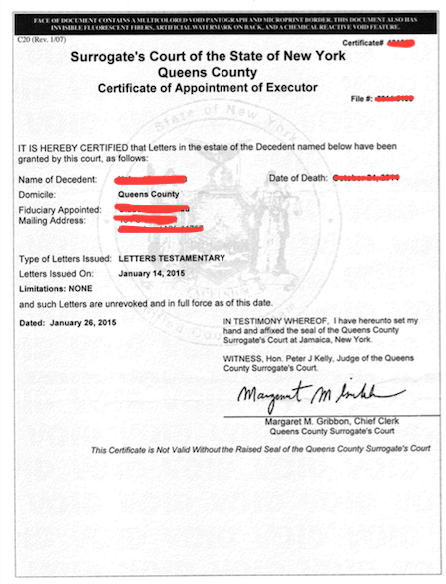
Once appointed, an executor of will will receive enough Certificates of Appointment of Executor of will to present to every bank and other institution when they marshal the assets of the estate. The Certificates of Appointment also have watermarks and security features. The certificates cost $6 each and can be obtained from the cashier in the courthouse. This is what a Certificate of Appointment of Executor of will would look like:
Preliminary Executor of a Will
If someone is objecting to the appointment of an executor, or the court is waiting for additional documents, but assets of the estate need to be taken care of, the court can issue preliminary letters testamentary, which give a person the power to take care of the estate assets but does not give them the power to disburse the assets to the beneficiaries of the estate.
In recent times, we have noticed that courts are more reluctant to appoint preliminary executors, as the extra work puts a strain on the court’s resources. We are trying to not apply for preliminary executorship unless necessary in the case.
Notice to All Heirs and Potential Heirs
An executor of will is required to give the proper notice to people affected by their appointment to that role.
A person who wishes to get appointed as the executor of will has to give notice of the probate proceeding to everyone who inherits under the will, relatives who would have inherited if not for this will, and people who would have inherited under a prior will that was overwritten by the current will.
Notice of probate is sufficient to people inheriting under the will. For people whose prior inheritance rights are terminated by the will, a citation issued by the court will be required.
In order to get appointed to be in charge of an estate, the potential executor of will will need to either obtain written waivers and consent of the people they notified or have to schedule a hearing date where the people notified of the date have a chance to appear and voice any of their reservations.
Affidavit of Sole Heirship
Whenever an executor of will is the sole heir of the decedent, they may be required to submit an affidavit of sole heirship, whereby a non-interested party who is familiar with the family of the person who died or a professional genealogist or perhaps even the attorney representing the executor of will who did the right research signs an affidavit which explains the family situation of the person who died and how it worked out that the person who died left only one heir.
Executor of a Will Commissions
Executors are usually entitled to compensation. This compensation is called “commissions.” The amount an executor of will is paid in New York is set by law, in SCPA 2307. Here are the commission percentages:
• 5% of the first $100,000
• 4% of the next $200,000
• 3% the next $700,000
• 2.5% of the next $4 Million
• 2% of the rest of the value of the estate
Fiduciary Duty of an Executor of a Will
An executor of will is held a higher standard of behavior and is expected to act in an honest, fair and ethical manner. If an executor of will breaches their fiduciary duty, the executor of will could be held legally liable for any losses suffered by the estate or beneficiaries. An executor of will in New York can be removed by the beneficiaries for breach of fiduciary duty and could be subject to restitution of any financial losses to the estate and beneficiaries, as well as face criminal charges if the executor of will committed any crimes such as embezzlement of estate assets.
Acting an executor of will is a big responsibility, especially if an estate is large and has substantial assets. That is why some spouses or family members decide they do not want to take on the job and end up resigning and hiring an attorney or another personal representative to replace them and administer the estate.
If you wish to speak to hire a New York estate attorney to assist you with your duties as executor, call the Law Offices of Albert Goodwin at (212) 233-1233.
Can an Executor Override a Will?
No. An executor cannot rewrite, ignore, or override the terms of a will. The will is the controlling document, and the executor's authority comes from two sources: the will itself and the Letters Testamentary issued by the Surrogate's Court. The executor's job is to implement the testator's intent, not substitute their own judgment for it. Within that framework, the executor does have genuine operational discretion — deciding when and how to sell assets, in what order to pay creditors, and when to make distributions. Beneficiaries sometimes mistake this routine administration for misconduct, but exercising discretion within the will's framework is not the same as overriding it.
There are, however, situations where an executor may appear to deviate from the will but is actually following New York law:
Ademption: When a Specific Gift No Longer Exists
When a will makes a specific bequest of a particular item — a named car, a particular painting, a specific parcel of real property — and that item is no longer part of the estate at death, the gift "adeems" and fails. The beneficiary receives nothing in its place. Under EPTL 3-4.3, an act by the testator that alters their interest in property revokes the disposition only as to the property affected — the rest of the will stands. New York also provides anti-ademption protections in limited circumstances, such as where property is sold by a guardian or under a power of attorney, or where insurance or condemnation proceeds are traceable. For example, if a will leaves "my home at 123 Maple Street" to a niece but the testator sold that home two years before death, the gift generally adeems — the executor is not overriding the will by failing to deliver it.
Abatement: When the Estate Cannot Pay Everything
If the estate lacks enough assets to satisfy all debts, taxes, and bequests, the executor must reduce gifts in the statutory order set by EPTL 13-1.3. Dispositions abate in this sequence:
- Property passing by intestacy (not disposed of by the will)
- Residuary dispositions
- General dispositions (specific dollar amounts)
- Specific dispositions (particular identified items)
Within each class, dispositions generally abate proportionately. An executor who pays creditors first and reduces a residuary gift before touching a specific bequest is following the statute, not overriding the will. Estate debts, administration expenses, and taxes are paid before beneficiaries receive anything, which is why a residuary beneficiary may end up with far less than expected.
Lawful Ways to Deviate from a Will's Terms
There are two legitimate paths for departing from a will's literal terms. The first is unanimous beneficiary consent. If all affected beneficiaries agree in writing, the executor may implement a variation without breaching their duty. Common consent-based variations include:
- Distributing a specific item to a different beneficiary than named, with the named beneficiary's written consent in exchange for other value
- Selling property the will directs be distributed in kind, then distributing the cash proceeds
- Holding back a distribution to offset a debt a beneficiary owes the estate
- Accelerating distributions the will staggered over time
Every affected beneficiary, not only those who benefit, must consent, and the executor should obtain the consents in writing.
The second path is court instruction. When a will is ambiguous, internally inconsistent, or impossible to apply literally, the executor should not guess. The executor can petition the Surrogate's Court in a will construction proceeding for a binding interpretation, then follow the court's decree. An executor who acts under a court order is generally insulated from later claims of mishandling, which makes this the safest route whenever there is genuine doubt about the will's meaning.
Self-Dealing and What Beneficiaries Can Do About It
An executor may never use the position to favor themselves. Self-dealing — selling estate property to oneself below market value, paying oneself unauthorized commissions, or moving estate funds into personal accounts — is a breach of fiduciary duty, not lawful discretion. New York applies a strict standard: even a transaction at fair value is suspect if the executor sits on both sides of it. The safer course is to avoid the transaction or obtain advance court approval.
Beneficiaries who believe an executor is not following the will have specific statutory tools. Under SCPA 2205, an interested party may petition the Surrogate's Court to compel the executor to file a formal accounting of all receipts, disbursements, and proposed distributions, and may then file objections to that accounting. A beneficiary who proves self-dealing or other misconduct can ask the court to surcharge the executor — that is, to hold the executor personally liable for the loss to the estate.
Grounds for Contesting an Executor's Appointment
Beneficiaries or disinherited heirs may object to the appointment of an executor by challenging the validity of the will that nominates them. To succeed, the objecting party will need to prove at least one of the following grounds:
- Lack of mental capacity
- Undue influence
- Fraud
- Duress
- Forgery
- The will was not executed correctly
Lack of Mental Capacity
To show mental incapacity, the objectant needs to prove that the testator did not understand one or more of the following: what they own, who their relatives and friends are, or what is in their will.
A challenge based on lack of capacity has a higher chance of success when the testator suffered from a dementia disorder, such as Alzheimer's disease, vascular dementia (often caused by a stroke), Parkinson's disease, frontotemporal dementia, or dementia resulting from head injuries, HIV or medications. The later the stage of dementia at the time the will was made, the more likely the challenge is to succeed.
Mental illness in and of itself does not mean the decedent lacked capacity. The objectant will need to prove that the mental illness played a role in the making of the will. Conditions such as depression, paranoia, bipolar disorder and schizophrenia can leave a testator vulnerable to manipulation by caretakers, relatives or acquaintances. Similarly, personality disorders are not indicative of a lack of capacity, but a dependent personality disorder can make a testator vulnerable to undue influence.
Physical factors also matter. A weak physical state can adversely influence mental capacity, and mind-altering pharmaceuticals such as sedatives, antipsychotics and pain medications can push a testator's mental state over the edge of capacity. Older people may also drift in and out of lucidity. New York courts still consider whether the testator had a lucid moment at the time of the will signing, and the attorney who supervised the will execution may testify to that effect.
An objectant does not have to prove that the decedent lacked capacity on the exact day of the will signing; circumstantial evidence of incapacity around that time can be used. The most effective strategy is often obtaining the decedent's medical records and reviewing them for notes pointing to incapacity, including prescriptions for Alzheimer's or dementia medications, sedatives and antipsychotics. Results of tests administered during the decedent's life, such as a Mini-Mental Exam or the Clock Test, can also be used as evidence.
Undue Influence and Duress
Undue influence means that a trusted person took advantage of the testator and manipulated them into making the will. Undue influence is most often proved by circumstantial evidence, including the facts and circumstances surrounding the testator, the nature of the will, the testator's family relations, the condition of their health and mind, their dependency upon and subjection to the control of the person supposed to have wielded the influence, and that person's opportunity and disposition to wield it. A common strategy is to prove that the person had a confidential relationship with the decedent, showing a position of influence and opportunity to pressure the testator.
Duress, by contrast, requires showing force or coercion — the use of force, false imprisonment, or threats to compel the testator to make the will a certain way. Duress often comes hand in hand with other forms of elder abuse.
Who Is Eligible to Serve as Executor in New York
Not everyone named in a will can actually serve. Under SCPA § 707, the Surrogate's Court may decline to appoint a person who is under 18, judicially declared incompetent, or a non-domiciliary alien (a non-U.S. citizen living outside New York), unless that person serves together with a New York resident. A felony conviction is an absolute bar to serving as executor in New York. The court can also find a nominee ineligible for "dishonesty, improvidence, want of understanding," or other unfitness, including substance abuse — though on those grounds, the party objecting must prove the nominee is genuinely unfit. A non-resident U.S. citizen may serve, but the court can require a bond.
Many wills direct that the executor serve "without bond," and New York courts honor that direction in most cases. The court still retains discretion to require a fiduciary bond — an insurance policy protecting the estate against the executor's misconduct — where circumstances warrant, such as a non-resident fiduciary, a fiduciary with creditor problems, or legitimate concerns raised by beneficiaries.
Recovering Assets and Paying Claims in the Correct Order
Not all of a decedent's property passes through the executor's hands. Assets with beneficiary designations (life insurance, retirement accounts), jointly held property with rights of survivorship, and property held in a living trust pass outside probate and are not controlled by the executor.
If the executor discovers that property belonging to the decedent is being withheld by a third party — a relative who emptied a bank account, for example — the executor can bring a discovery and turnover proceeding under SCPA § 2103. This is one of the executor's most important enforcement tools for recovering missing or misappropriated estate assets.
When the estate cannot pay everyone in full, New York imposes a statutory order of priority for paying claims. Under SCPA § 1811, debts entitled to preference under federal or New York law are paid first, followed by reasonable funeral expenses, then administration expenses, then other debts. An executor who pays a lower-priority claim before a higher-priority one, leaving insufficient assets for the senior claim, can be held personally liable for the shortfall.
The executor must also handle tax obligations, including:
- The decedent's final personal income tax returns
- The estate's fiduciary income tax returns
- New York and federal estate tax returns, where the taxable estate exceeds the applicable exemption
The Seven-Month Creditor Period
New York gives creditors a window to present claims against the estate. Under SCPA § 1802, claims must generally be presented within seven months of the date letters testamentary are issued. An executor who distributes estate assets to beneficiaries before this seven-month period expires does so at personal risk: if a valid creditor later appears and the estate assets have already been distributed, the executor can be held personally responsible for the claim. For this reason, we generally advise executors to wait out the seven-month period before making distributions.
Can an Executor of a Will Remove a Beneficiary?
No. Under New York law, an executor of will cannot remove a beneficiary named in the will. The executor's authority comes entirely from the will, and the will reflects the testator's decisions about who inherits. The executor's job is to carry out those decisions, not to override or rewrite them. The executor does not own the estate property and has no personal discretion to decide who is "worthy" of an inheritance.
After the estate's debts, taxes, and administration expenses are paid, the executor must distribute the remaining property to the beneficiaries the will names. An executor who refuses to distribute to a named beneficiary, or who tries to redirect property to someone the will does not name, is acting outside their legal authority. In that situation, the beneficiary can compel the proper distribution through the Surrogate's Court, and the executor can be surcharged (held personally liable) for any resulting losses in addition to being removed.
When a Named Beneficiary Lawfully Receives Nothing
Although an executor of will cannot remove a beneficiary, certain legal doctrines can cause a named beneficiary to receive a reduced inheritance or nothing at all. In each of these situations, the executor is applying New York law to the facts, not exercising discretion to remove anyone.
Insufficient Assets and the Order of Abatement (EPTL § 12-1.2)
If there is not enough left after debts and expenses to satisfy every bequest, New York's order of abatement determines who is paid first. Under EPTL § 12-1.2, unless the will shows a different intent, property is applied to distributions in this order:
- The surviving spouse, for dispositions qualifying for the estate tax marital deduction
- Specific beneficiaries (gifts of a particular identified item or asset)
- General beneficiaries (gifts of a stated dollar amount)
- Residuary beneficiaries (those who receive "the rest" of the estate)
- Distributees (heirs taking by intestacy)
For example, if only $10,000 remains after debts and expenses, and the will makes $10,000 in specific gifts with the residuary estate going to the testator's brother, the specific gifts consume the entire estate and the brother receives nothing. The executor did not remove him — the statutory order of abatement simply left nothing for the residuary.
Lapse and the Anti-Lapse Statute (EPTL § 3-3.3)
If a beneficiary dies before the testator, the gift to that beneficiary generally lapses unless the will provides otherwise. New York's anti-lapse statute, EPTL § 3-3.3, saves certain gifts: when the predeceased beneficiary is the testator's issue or sibling, the gift passes to that beneficiary's surviving issue. If the anti-lapse statute does not apply, the lapsed gift falls into the residuary estate.
Ademption
If the will makes a specific bequest of a particular item, a particular car or particular shares of stock, and the testator no longer owns that item at death, the gift adeems and fails entirely. The named beneficiary receives nothing in place of the missing asset, because the gift was tied to a specific thing rather than to value.
Statutory Disqualification
Certain beneficiaries are disqualified by statute regardless of what the will says. A surviving spouse who abandoned the decedent, or who failed to support the decedent when obligated to do so, can be disqualified under EPTL § 5-1.2. Separately, New York's "slayer rule" bars a person who feloniously and intentionally killed the decedent from inheriting. The executor merely applies these rules — the disqualification arises from the law, not the executor's choice.
Voluntary Disclaimer (EPTL § 2-1.11)
A beneficiary may voluntarily refuse an inheritance by filing a qualified disclaimer, often for tax planning or asset-protection reasons. Under EPTL § 2-1.11, the disclaimer must generally be in writing, signed and acknowledged, and filed within nine months of the testator's death, among other technical requirements. The property then passes as if the beneficiary had predeceased the testator. A disclaimer is irrevocable, and the executor cannot force a beneficiary to disclaim.
Set-Off for Debts Owed to the Estate
If a beneficiary owes money to the estate, such as an unpaid loan from the decedent, the executor may set off that debt against the beneficiary's distribution, so the beneficiary receives the net amount. Set-off requires provable documentation, and the executor should give the beneficiary notice and an opportunity to dispute the underlying debt. If the debt is contested, the matter may have to be resolved by the court.
Unmet Conditions in the Will
Some wills contain conditional gifts — a bequest that depends on the beneficiary reaching a certain age, surviving the testator by a stated period, or meeting another condition. The executor's role is to determine whether the condition has been satisfied. If the condition fails, so does the gift, and the property passes according to the will's other provisions.

About the Author
Albert Goodwin Esq. is a licensed New York attorney with over 18 years of courtroom experience. His extensive knowledge and experience make him well-qualified to write authoritative articles on a wide range of legal topics. He can be reached at 212-233-1233 or [email protected].



