







Mr. Goodwin is everything you want in an attorney: professional, honest, thorough, and genuinely caring. He always explains things clearly, so I understood exactly what was happening and what to expect next. His attention to detail and persistence really stood out. Looking back, I feel lucky to have found him. He guided me through the whole process expertly, and I deeply appreciate all his hard work. Would definitely recommend him to anyone needing legal help.
Call Today:
212-233-1233
Can a Child Contest a Will if Excluded from Said Will by the Will Maker in New York City
If you are a child who is excluded and are looking to contest a will, then you will need to prove at least one of the following will contest grounds:
- lack of mental capacity
- undue influence
- fraud
- duress
- forgery
- the will was not made correctly
Does an Excluded Child Have Standing to Contest?
Before getting to the grounds, the child has to have the legal right to object at all. Under SCPA 1410, only a person with a pecuniary interest – someone who would be financially worse off if the will is admitted to probate – has standing to file objections. An excluded child almost always qualifies, in one of two ways.
As a distributee
A distributee is a relative who would inherit under the intestacy statute, EPTL 4-1.1, if there were no will. The spouse and children come first; if there are none, the parents; if there are no parents, the siblings. Because a child is a distributee, a will that leaves the child nothing takes money away from what the child would otherwise receive, and that is exactly the adverse financial effect that confers standing.
For example, if you were an only child and your father died without a surviving spouse, you would inherit the entire estate if he had no will. If his will instead leaves everything to his mother (your grandmother) and nothing to you, you can object to the will.
What if you were estranged from your parent? You have not spoken to your father in a decade, and his will leaves everything to his mother. You still have standing. Estrangement does not change who the distributees are; it only means that, if the case goes to trial, the proponent will argue that the estrangement explains why you were left out. It remains up to you to prove one of the grounds below.
What if your parents were never married? A child born outside marriage inherits from the mother automatically. To inherit from the father – and therefore to have standing to contest his will – the child must first establish paternity under EPTL 4-1.2: through a court order of filiation, an acknowledgment of paternity signed by the father, or clear and convincing evidence of paternity, which can include DNA testing and proof that the father openly and notoriously acknowledged the child as his own. Only after paternity is established can the child proceed with the contest.
As a beneficiary of a prior will
A person who is not a distributee can still contest if he or she was a beneficiary under an earlier will and would receive less under the will being offered for probate. The comparison matters. If Beneficiary A was left $10,000 in a 1980 will and the same $10,000 in the 1982 will now offered, A has no standing to contest the 1982 will, because admitting it does not cost A anything. If A was left $15,000 in the 1980 will but only $5,000 in the 1982 will, A has standing, because admitting the 1982 will costs A $10,000.
1. Lack of Mental Capacity

To show mental incapacity, an child needs to prove that the parent who excluded them did not understand one or more of the following:
- what they own
- who their relatives and friends are
- what is in their will.
Dementia Disorders
A will contest based on a lack of mental capacity has a higher chance of success when the testator suffered from a dementia disorder.
- Alzheimer’s – this is the biggest cause of dementia. Early-onset can start as early as the age of 40 or 50, and progresses with age. It destroys cognitive functioning and may cause them to lose the capacity to make a will.
- Vascular Dementia – often caused by a stroke, results from obstruction of blood flow to the brain
- Parkinson’s Decease – degeneration of nerves in the brain.
- Frontotemporal Dementia – deterioration and shrinkage in front and side areas of the brain
- Dementia due to head injuries
- Dementia due to HIV or medications
Changes in memory and behavior in older adults usually point to dementia. The gradual cognitive decline caused by a degenerative condition eventually results in the loss of mental capacity required to make a will. The more dementia progresses, the harder it becomes to make decisions. Therefore, the later the stage of Dementia, the more likely it is for the will challenge to succeed.
Mental Illness
Mental illness in and of itself does not mean that the decedent lacks capacity. For a will contest to work, a child will need to prove that mental illness played a role in the making of the will. Some examples of mental illness that can impact the capacity to make a will are:
- Depression – The will-maker feels hopeless and passive and does not care what happens to their estate. The elderly often suffer from depression towards the ends of their lives. Family conflicts relating to inheritance only exacerbate their depression.
- Paranoia – The pervasive distrust of people with paranoia can make it easier to manipulate and “triangulate” them into excluding some people from their will.
- Bipolar – People suffering from bipolar disorder experience mood swings from extreme highs (mania) to extreme lows (depression). Caretakers, relatives and acquaintances can exploit those mood swings to get a person to favor them in their will.
- Schizophrenia – People with schizophrenia experience delusions and distorted reality. Caretakers, relatives and acquaintances can take advantage of those mental deficiencies in order to manipulate the person into making a will bequest.
Personality Disorders
Personality disorders are not indicative of a lack of capacity. But they can still make some difference in a New York will contest. For example, if the testator had a “Cluster C” Dependent Personality Disorder, then they can be vulnerable to undue influence. We look to symptoms such as
- excessive dependence on others
- submissive behavior
- fear to have to provide self-care
- difficulty disagreeing with others and
- tolerance of poor or abusive treatment
Physical Factors
Weak Physical State – We challenge wills of decedents whose weak physical state adversely influenced their mental capacity.
Mind-Altering Pharmaceuticals – If the testator was taking mind-altering pharmaceuticals during the will execution, then his capacity to execute a will could be diminished. Sedatives, antipsychotics, and pain medications can push a mental state over the edge of capacity.
Drifting in and Out and Lucid Moments – Older people may drift in and out, sometimes lucid and sometimes not. If a child contesting the will, the child will need to show that the decedent was not having any lucid moment. An attorney who made the will may testify that the testator had a lucid moment when he executed the will.
Some will contest lawyers and medical professionals hold the view that the lucid moment concept is out of date with the modern understanding of mental capacity. Their view is once the testator lost mental capacity, he does not get it back. However, at this time, our courts still consider lucid moments, so this is an important factor to consider in New York will challenges.
Pro tip: Circumstantial Evidence – In contesting a will, we don’t have to prove that the decedent lacked capacity on the exact day of the will signing. Instead, we can use circumstantial evidence to show that the decedent lacked capacity during at that time.
Pro tip 2: Obtain Medical Records – When figuring out how to contest a will, the most effective strategy for challenging the decedent’s mental capacity is to obtain medical records from the medical providers. You can then go through those medical records and see if any notes point to incapacity. It’s good to check for a list of Alzheimer’s or dementia medications, sedatives and antipsychotics. You can find a list online.
Different forensic and analytical tests will be used to asses the mental capacity of the testator. The decedent might have been administered a Mini-Mental Exam or the Clock Test while they were still alive. After their death, we can no longer give them a test. But we can still use models of mental capacity such as PARADISE – 2 to argue that the decedent had impaired brain function at the time of the events in question.
2. Undue Influence and Duress

In will contest parlance, pressure to make a will is called duress and manipulation of the testator is called undue influence.
Undue Influence – To prove undue influence, the child who was excluded would have to show that a trusted person took advantage of the testator and manipulated him into making the will.
While undue influence most often is not the subject of direct proof, it may be proved by circumstantial evidence. It can be shown by all the facts and circumstances surrounding the testator, the nature of the will, his family relations, the condition of his health and mind, his dependency upon and subjection to the control of the person supposed to have wielded the influences, the opportunity and disposition of the person to wield it, and the acts and declarations of such person.
Duress – To prove duress, a child who was excluded would have to show force and coercion. Duress is the use of force, false imprisonment, or threats to compel the testator to make the will a certain way. Duress usually comes hand in hand with other elder abuse. The abuser uses violence or the threat of violence to get a testator to change his or her will in the abuser’s favor.
Pro tip: Prove a Confidential Relationship – A common undue influence strategy is to prove a confidential relationship with the decedent, showing a position of influence and opportunity to pressure the testator.
This confidential relationship power-up does not work well when the beneficiary of the will is a relative. It only works well when the person benefitting from the will is a caretaker or a different professional helping the testator.
3. Forgery
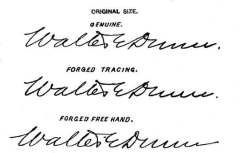
If somebody forged a part of the will and we can prove the forgery, then we can have the Surrogate’s Court declare the will to be invalid. When figuring out how to contest a will, the child who was excluded will likely need to hire an expert familiar with the different forgery methods. The expert will examine the suspect will, prepare a report and testify in court.
How People Forge Wills – A forgery can either be of the signature or the document. Signature forgery is copying the signature, tracing it, or pasting it from a different document. Forgery of the document is replacing the pages or changing the text.
Handwriting Expert – We win forgery will contests by bringing a handwriting expert to present evidence of other handwriting samples of the deceased. The handwriting expert compares the handwriting on the will and testifies that it’s not a close enough match. The handwriting expert would also determine if the handwriting on the will belongs to someone else, such as the person benefiting from the will.
Pro tip: – A forgery trial can easily become a battle of the experts. Getting the most presentable and authoritative expert can make all the difference.
4. Fraud

In figuring out how to contest a will based on fraud, we will need to show that the beneficiaries knowingly misled the decedent to make him sign the will. We do that, and the will can be overturned and declared invalid.
Fraud in Factum – One type of fraud is misleading the decedent about the will itself. Beneficiaries slip a will under a guise of a different document or mischaracterize what is in the will and have the testator unknowingly sign it.
Fraud in the Inducement – Another type of fraud is misleading the testator about circumstances outside of the will. They can be fed misinformation about friends and relatives or other things in their lives.
Psychopaths with narcissistic personalities are good at using manipulative tactics. Their favored ways of manipulating vulnerable seniors are
- triangulating – encouraging the victim’s negative thoughts about a close person and
- gaslighting – providing a false view of reality to the victim
Opportunistic charlatans use those techniques to manipulate trusting older adults into leaving them an unfair share of the inheritance at the expense of the vulnerable person’s family and true wishes.
5. Lack of Due Execution

For a will to be valid, the people involved in the will execution need to follow New York’s formal requirements. If they did not correctly execute the will, we could successfully contest that will, leading to the will being overturned and invalidated by the Surrogate’s Court. In figuring out how to contest a will, the child who was excluded will need to be familiar with the formal requirements of will execution.
The will need to meet the formal requirements, which are as follows:
- The person making the will has to sign the will (or direct someone else to sign their will in their presence)
- The person making the will has to sign at the end of the will, not in the middle of it.
- There need to be two witnesses to the will
- The person making the will has to sign the will in the presence of each witness
- The person making the will must communicate to the witnesses that they are witnessing a will
- the two witnesses must sign within the same 30-day period (EPTL 3-2.1(a)(4))
The people involved have to follow New York execution formalities. Problems can creep up, such as when the testator did not declare the document to be their will, or the witnesses are not there or not fully there. We can use those “hiccups” to litigate a successful will challenge in New York.
There is little place left for ceremony in the modern world. A will execution is one of the few exceptions, and it needs to be followed precisely in order for a will to be valid.
Pro tip: Will Printed from the Internet vs. Attorney-Drafted Will – When a person prints out a will from the internet or fills out a store-bought form, they are playing Russian Roulette with the validity of their will. It is easy to figure out how to challenge a DIY will. No estate attorney would possibly testify to support such a will, because no attorney was involved in making it.
6. Revocation

A testator can revoke a will by destroying it or crossing out the signature.
If no one can find the will, we presume that the testator revoked it, unless someone proves otherwise.
A testator can revoke a will by making a new one. The latest will always controls, unless overturned, in which case we revert to the will before that.
When It Rains, it Pours – When figuring out how to contest a will, we often plead every possible ground for a New York will challenge, hoping that we find one that sticks. If the decedent was not well enough to make a will, then he was probably vulnerable to being misinformed or pressured to make a Will.

It is true that in some will contest situations, an opportunity for a win can be spotted early on in the case. We can then proceed with a laser-sharp focus on a single issue. However, the most common strategy is still to plead every possible Will contest ground and see which one of them turns out to be more successful.
If you a child who was excluded and are considering way to contest the will, contact an estate attorney. You will describe the circumstances of the making of the will and air out the case. An estate attorney can determine whether the proposed objections have merit. Estate attorneys usually request court-supervised depositions of the people involved before deciding whether it is worth your while to invest in a full-blown will contest.
We try to settle will contests before trial. If a settlement is not possible, then the sides will proceed to exchange more documents and information, and ultimately progress to trial. The judge or the will jury decide whether the will is valid.
Remedies for a Defective Will
When your lawyer is contesting a will, the court will decide at a trial whether the will is valid. The executor is not permitted to distribute the estate until after the trial. If the court finds the will to be invalid, the court will do one or more of the following:
- Not admit the will
- Admit only a portion of the will
- Admit an earlier will in its place
- Not admit any of the wills, and distribute assets among the decedent’s relatives as if there was no will.
| Deadline Alert: | Once the will is admitted to probate, it will be too late to challenge it. Act before the first hearing in the case. |
|---|
Frequently Asked Questions from Excluded Children
What if I was left out because the will was made before I was born or adopted?
That is not really a will contest. A child born or adopted after the will was signed, and neither provided for nor mentioned in it, is an "after-born child" under EPTL 5-3.2. The statute does not throw out the will; it gives the after-born child a share carved out of what the other children receive (or an intestate share if the will made no provision for any children). If your parent's will predates your birth or adoption, ask about EPTL 5-3.2 before objecting to probate.
Who pays for the investigation before objections are filed?
The first step for an excluded child is almost always an examination under SCPA 1404 of the attorney who drafted the will and the attesting witnesses. The court costs of that examination, such as the stenographer, are charged to the estate rather than to the child; the child pays only his or her own lawyer. The 1404 examination also lets the child obtain the decedent's medical and financial records for the period described below. Once the examinations are finished, objections are generally due within 10 days, so the decision whether to go forward has to be made promptly.
How far back can I get medical records?
Under 22 NYCRR 207.27, the Uniform Rules for the Surrogate's Court, pre-objection discovery is limited to the period from three years before the will was signed to two years after it, or to the date of death, whichever is shorter. This is called the "3/2 rule." The court can expand the window on a showing of special circumstances, such as a long-standing dementia diagnosis, but you should plan the case around the 3/2 period.
Does a no-contest clause stop me from contesting?
A no-contest (in terrorem) clause says that a beneficiary who contests the will and loses forfeits whatever the will gave him or her. Under EPTL 3-3.5, conducting SCPA 1404 examinations does not trigger the clause, because no objections have been filed yet. And a child who was left out entirely has nothing in the will to forfeit, so the clause has no bite at all. The clause matters only if the will gave you something and you are weighing whether to risk it by objecting.
Should I settle?
Will contests are expensive, and they are emotionally draining when the other side is your own family. Weigh what you stand to recover against the fees and costs of a full contest, and use the 1404 examinations to size up the evidence before committing. When the case is strong – especially when the will was not drafted or supervised by an attorney, so it carries no presumption of due execution – the executor will often settle rather than spend estate money defending it. Most of our will contests resolve before trial.
For making wills, unscrupulous people can take advantage of vulnerable individuals. Unscrupulous relatives, caretakers and so-called “friends” with ulterior motives prey on people who are physically disabled, cognitively impaired, isolated, confused and depressed. A victim of will fraud often loves, relies on, and fully trusts the person who misleads them. If you are a child who was excluded and you want to contest the will, you believe that someone took advantage of your parent, you may be able to overturn their so-called “will.” This is done with the help of a lawyer through a will contest in New York Surrogate’s Court.
A will is presumed to be valid unless proven otherwise. If a testator wants to set up their will a certain way, it’s their business. In New York, you can disinherit your relatives if you wish to do so.
You should never go into a will contest without trial counsel. Even though you now have all this information, you will still be at a great disadvantage because you don’t have the experience in contesting a will.
Attorney Albert Goodwin has been litigating New York will contests for over a decade. We at the Law Offices of Albert Goodwin can help. We have offices in New York City, Brooklyn, NY and Queens, NY. You can call us at 212-233-1233 or send us an email at [email protected].

About the Author
Albert Goodwin Esq. is a licensed New York attorney with over 18 years of courtroom experience. His extensive knowledge and experience make him well-qualified to write authoritative articles on a wide range of legal topics. He can be reached at 212-233-1233 or [email protected].



